You can see a lot of Florida’s best springs on a single well-planned weekend if you pick a base and work outward instead of chasing every spring on the map. Below are three itineraries we’d actually drive ourselves — the Santa Fe River cluster near High Springs, Ocala National Forest, and an Orlando-area day-trip loop — plus a shorter fourth option for the Panhandle.
Itinerary 1: Santa Fe River cluster (2 days, base in High Springs)
This is the tightest, most efficient springs cluster in the state — five distinct springs within about a 20-minute drive of each other, all feeding into or near the Santa Fe River. Base yourself in High Springs; it’s a small town with a walkable downtown, several inns and vacation rentals, and it puts every stop on this itinerary within 15 minutes. We cover this same cluster in more depth, including logistics for doing it in one long weekend, in the Santa Fe River springs cluster guide.
Day 1
Start early at Ichetucknee Springs State Park (about 20 minutes from High Springs) — arrive at the launch by 9am if you want a tubing or paddling run before the day gets crowded, especially in summer when the North launch is capped at 750 people per day and the Midpoint launch is closed for 2026, leaving only the shorter Dampier’s Landing run downstream. Spend the morning here, grab lunch in Fort White or back in High Springs, then head to Rum Island Spring in the afternoon for a swim in some of the clearest water in the cluster. Normally we’d send you to Gilchrist Blue Springs for this slot, but its water areas have been closed for construction renovations since late 2025 with no confirmed reopening date, and Poe Springs’ own water area is currently closed due to low water levels (checked Sep 2026), so Rum Island is the better bet for now.
Day 2
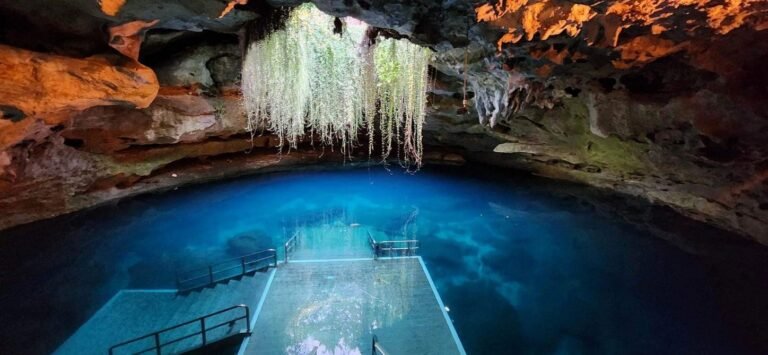
Morning at Ginnie Springs — privately run, no pets allowed anywhere on property, day passes stop being sold at 3pm and expire at sunset, and expect to pay $25/adult March–October or $20/adult November–February (kids 4–12 are $6/$5, under 3 free). The famous limestone “bowls” and cavern entrances here are popular with certified cave divers; open-water divers and snorkelers stay in the open sections. From Ginnie, it’s a short hop to Poe Springs and Rum Island Spring — Poe is $6/vehicle May through September and free October through March, though its water area is currently closed due to low water levels (checked Sep 2026), so it’s a walk-around-the-park stop rather than a swim right now; Rum Island is a Columbia County park running $5/vehicle and is the one to actually get in the water at. Both are smaller, quieter, and a nice contrast to Ginnie’s crowds. If you have energy left or an extra half-day, drive about 35–40 minutes to Devil’s Den or Blue Grotto near Williston for a snorkel or dive in a genuinely different kind of spring — an underground cavern rather than an open-air pool. Devil’s Den snorkeling runs $30 by reservation and scuba $48; Blue Grotto is $61 for a dive, $23 for snorkel.
Budget and logistics
Rough two-day per-person total for entry fees alone: Ichetucknee ($6/vehicle if you’re splitting a car, plus tubing shuttle if applicable), Rum Island in place of Gilchrist Blue and Poe while both are unswimmable ($5/vehicle), Ginnie ($20–25), Devil’s Den snorkel ($30) — figure $65–85 per person for a full two-day run depending on group size and whether you add the cavern stop. Reserve Ichetucknee tubes/parking and Gilchrist Blue capacity slots in advance during summer weekends; see our reservations and capacity guide before you go.
Itinerary 2: Ocala National Forest loop (2–3 days, base in Silver Springs or Ocala)
This route strings together the forest’s big, less-crowded springs with one of the state’s most famous. Base near Silver Springs or in Ocala proper — both put you within 45 minutes of every stop below, and Ocala has the widest range of lodging.
Day 1
Silver Springs State Park — one of Florida’s largest first-magnitude springs and home of the original glass-bottom boat tours, which are still worth doing even if you’ve seen photos; the clarity over the main spring run is dramatic from the boat in a way it isn’t from the bank. Swimming here is limited to a designated area rather than the main spring run, so set expectations before you go. Spend the afternoon walking the park’s nature trails or paddling the spring run by kayak.
Day 2
Drive about 30–35 minutes into the national forest to Silver Glen Springs for the morning — a striking turquoise boil with a sand bottom, $14.50/person as a U.S. Forest Service fee site, and genuinely one of the prettiest swimming spots in the forest. From there it’s roughly 20 minutes to Juniper Springs, also $14.50/person, known for its cool spring run and the classic canoe run downstream through the forest if you want to paddle rather than just swim.
Day 3 (or afternoon of Day 2 if you’re tight on time)
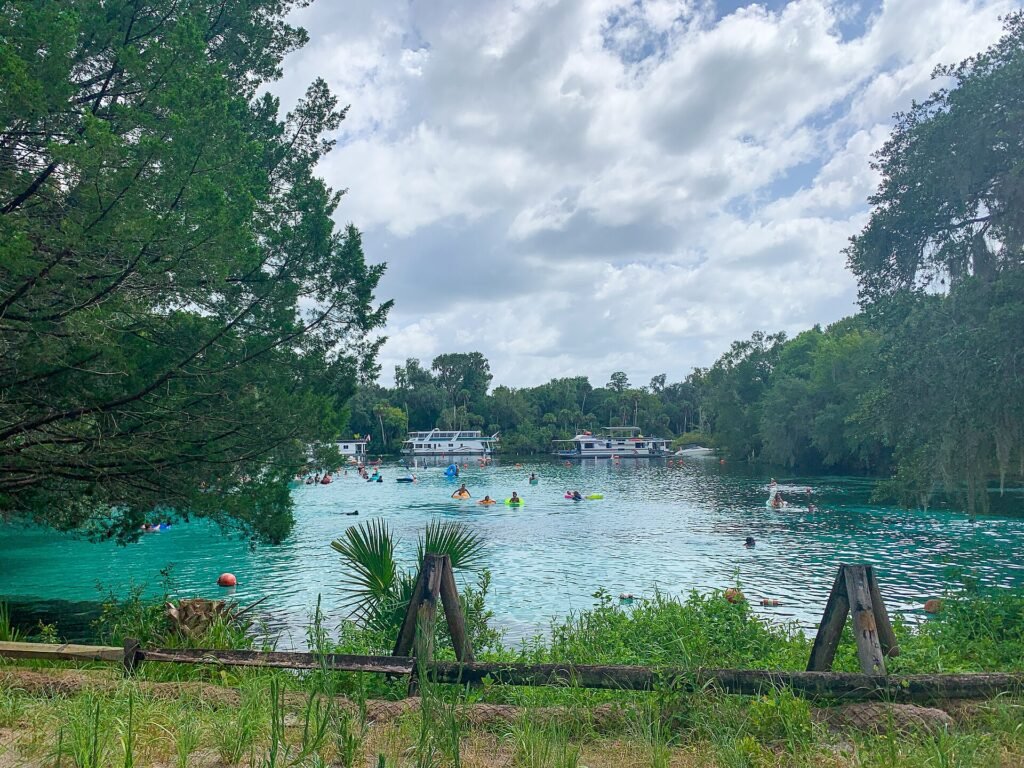
Head to Alexander Springs (about 30 minutes from Juniper) for a first-magnitude spring with a sandy beach entry and good snorkeling over the grass beds, then finish at Salt Springs (another 30–35 minutes) — a large, family-friendly spring run at $14.50/person plus tax day use (the same rate as Juniper, Alexander, and Silver Glen) with a nearby marina and campground if you want to extend the trip with a night under the pines.
Budget and logistics
Per-person fee total for this loop runs roughly $14.50 + $14.50 + entry to Alexander (state-park style vehicle fee, split across your car) + $14.50 for Salt Springs — call it $50–60 per person across the full loop, plus Silver Springs park entry. All three national forest springs (Silver Glen, Juniper, Alexander) charge per-person rather than per-vehicle, so a full car actually costs more here than at a state park — budget accordingly for a group.
Itinerary 3: Orlando day-trip loop (1–2 days, base in Apopka or Orlando)
If you’re staying in the Orlando area and want a break from theme parks, this loop hits four springs without ever putting you more than about 45 minutes from your hotel. Base in Apopka for the shortest drives, or stay in Orlando proper if you’re combining this with other plans.
Morning
Wekiwa Springs State Park requires an advance day-use reservation, so book before you leave the hotel — it’s a second-magnitude spring with a sand-bottom swimming area and one of the closer-to-Orlando spots to actually feel like you’ve left the city. From Wekiwa it’s about 15 minutes to Kelly Park (Rock Springs), where the current is strong enough that floating the spring run on a tube is basically the whole point — bring your own tube or rent nearby, since the park itself doesn’t rent them.
Afternoon
Drive about 35 minutes to Blue Spring State Park in Orange City — a first-magnitude spring with a long boardwalk along the run that doubles as one of the best manatee-viewing spots in the state come winter (the run itself closes to swimming during manatee season, roughly mid-November through mid-March; verify exact dates with the park). Finish the day about 15 minutes away at De Leon Springs State Park, home of the Old Spanish Sugar Mill restaurant where you griddle your own pancakes at the table — a genuinely fun, low-key way to close out a springs day with kids.
Budget and logistics
Four state-park-style vehicle fees at roughly $6 each (split across your car) makes this the cheapest of the three itineraries — figure $25–30/vehicle for the full loop, plus Wekiwa’s advance reservation fee. Reserve Wekiwa ahead; the other three are generally walk-up outside of peak summer weekends, though checking current capacity rules before a Saturday visit is still worth it.
Bonus: Panhandle option (2 days, base in Marianna or Chipley)
If you’re already in the Panhandle, string together Morrison Springs, Vortex Spring, Ponce de Leon Springs, Jackson Blue Spring, and Cypress Springs — all within roughly an hour of each other around Washington and Jackson counties. Morrison and Ponce de Leon are quiet, low-fee state and county parks good for a relaxed swim; Vortex is a dedicated dive resort ($15/adult, $10/child) with a deep basin popular for open-water certification dives; Jackson Blue is a first-magnitude spring feeding Merritt’s Mill Pond, popular with divers and paddlers; Cypress Springs is a favorite for a lazy tube or kayak float. Base in Marianna for the shortest drives between all five.
Common questions
Which itinerary is best for a first-time visitor to Florida springs?
The Santa Fe cluster — it packs the widest variety (open swimming, cave diving, tubing, a private spring, a state park) into the smallest driving radius, so you get a real feel for how different springs can be from each other in one weekend.
Do I need reservations for all of these?
Not all, but check each park before you go — Wekiwa and Rainbow require advance day-use reservations, other popular state parks can hit capacity on summer weekends (Gilchrist Blue’s water is closed for construction as of 2026, so it’s not part of the capacity question right now), and Devil’s Den/Blue Grotto require reservations for snorkel and dive slots.
Can I do any of these loops in a single long day?
The Orlando loop is the most realistic to compress into one long day if you skip De Leon Springs’ restaurant stop. The Santa Fe cluster and Ocala loop are both better as overnight trips — the drive times are short, but each spring rewards lingering rather than rushing.
Which loop is most kid-friendly?
The Orlando loop — Kelly Park’s tubing current, Blue Spring’s boardwalk and manatees, and De Leon Springs’ pancake house are all built for families.
Sources / verified against: individual state park, U.S. Forest Service (Ocala National Forest), and county park websites for each spring listed, plus current 2026 fee schedules published by those agencies.