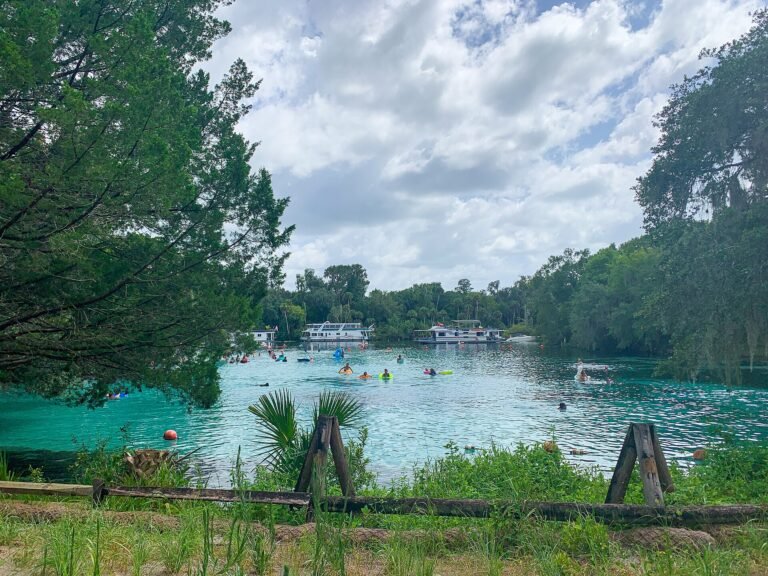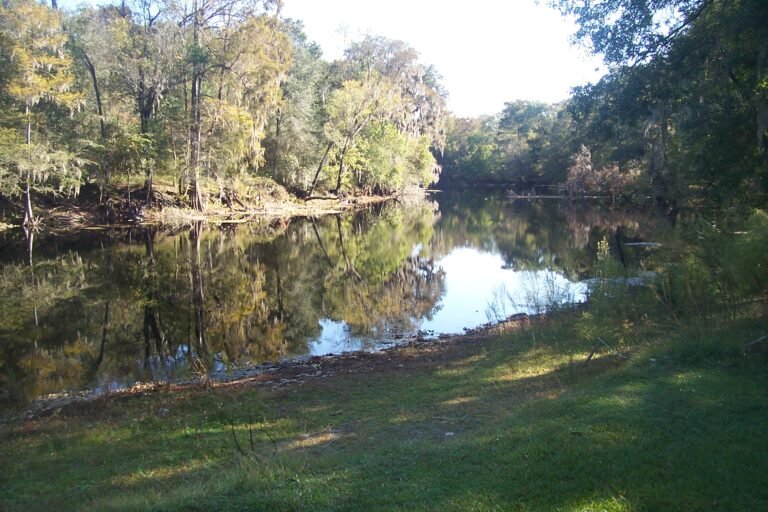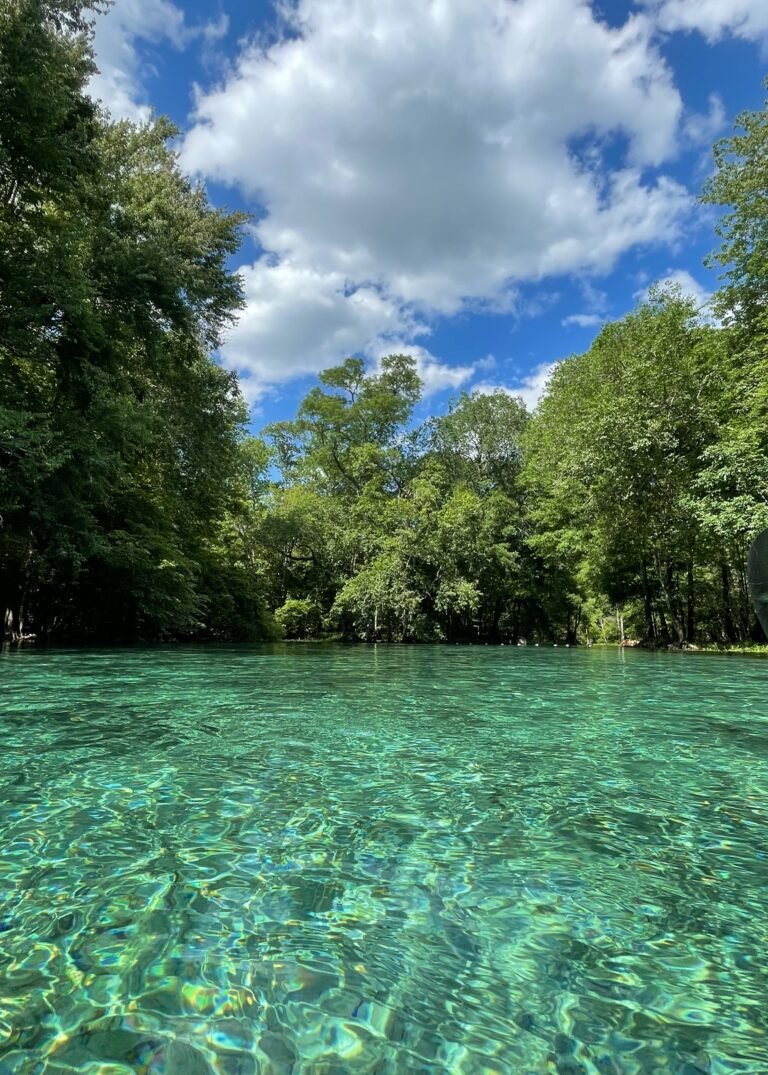
Snorkeling a Florida spring takes a mask that seals, a snorkel you can clear, and about ten minutes of getting comfortable with 72°F water before the visibility and the fish stop feeling incidental and start being the whole point. You don’t need fins at most springs, and you don’t need to be a strong swimmer — you need a mask that fits and the discipline to float instead of kick.
Gear that actually matters
Mask fit beats everything else on this list. Press the mask to your face without the strap, inhale gently through your nose, and it should stay stuck with no strap at all — if it falls off or leaks air, try a different size or shape before you buy. A snorkel with a splash guard or dry-top valve is worth the extra few dollars if you’re snorkeling near any current or boil turbulence; a basic semi-dry snorkel still lets some water in when a wake or a kid’s cannonball hits nearby, but far less than a plain open tube.
Several spring swim areas restrict or ban fins to protect both swimmers and the bottom vegetation — check signage at Ginnie’s swimming areas and similar spots before you strap them on. Where fins aren’t allowed, you’re better off without them anyway; the point of most spring snorkeling is floating and looking down, not covering distance.
At 72°F, most people are comfortable in a swimsuit for 20–30 minutes before they start feeling it. If you’re planning an hour or more in the water, or you run cold, a shorty wetsuit or a rash guard with some thickness makes a real difference — the water doesn’t warm up the longer you’re in it the way a pool does on a hot day; if anything it feels colder the second time you get back in after warming up on the bank.
Technique: clearing, equalizing, and not touching the vegetation
Clearing your snorkel — blasting a sharp exhale to push water out of the tube after a dunk or a wave — is worth practicing in shallow water before you’re 15 feet down over a boil. Equalizing your ears matters more than people expect in springs; a run like Ginnie’s Ballroom or the deeper boils at Blue Grotto drop fast, and most people start feeling ear pressure somewhere around 10–15 feet. Pinch your nose gently and swallow or exhale softly against closed nostrils the moment you feel pressure — don’t wait until it hurts.
The biggest beginner mistake in a Florida spring specifically is kicking near the bottom. Spring vegetation (eelgrass, sagittaria) is slow-growing and easily torn up by fin kicks or hands used to “swim down,” and disturbed sediment ruins the visibility for everyone behind you, including yourself on the way back. Float flat, arms at your sides or gently sculling, and let your body ride a few feet above the grass rather than skimming it.
Where to start: beginner springs
Blue Spring State Park‘s run is calm and well-suited to first-timers outside of manatee season (the run closes to swimming when manatees are present in winter — check our manatee season guide for current dates). Silver Glen Springs combines a sandy, easy-entry swim area with a boil you can see clearly from the surface without diving down at all — good for someone snorkeling for the first time anywhere, not just in a spring, and it’s our top current pick for a beginner. Alexander Springs offers a similar gentle, sand-bottomed entry. Gilchrist Blue Springs is normally just as forgiving — clear, shallow near the swim area — but its water has been closed for construction renovations since late 2025 with no confirmed reopening date, so it’s a spring to add back to your shortlist once that work is done rather than one to plan around today.
Rainbow Springs‘ headsprings area rewards snorkeling with some of the best visibility of any spring on this list on a clear day, though it now requires an advance day-use reservation. Devil’s Den is a different kind of beginner spot — an underground cavern spring where you snorkel on the surface of a sinkhole rather than a river run; it’s by-reservation and costs $30 for snorkeling in 2026, but the setting (a hole in the earth roofed in stalactites) is unlike anything else on this list, and staff keep a close eye on the water.
Stepping up: intermediate spots
Ginnie Springs‘ Ballroom is worth naming specifically because people get confused about what they’re allowed to do there. The Ballroom is a cavern and cave system — entry into the cavern itself is scuba-only, for certified divers with the right training. As a snorkeler you can float on the surface of the Ballroom’s open basin and look down into the cavern mouth from above; it’s a striking view even without going in, but going in requires certification, not just fins and a mask. We cover this in more depth in our diving guide below.
Three Sisters Springs near Crystal River is where snorkeling shifts from “look at the fish” to “share the water with a manatee,” seasonally. When manatees are present, the rules are strict and enforced by on-water staff: passive observation only, no chasing, no touching, no cornering an animal against a wall or bank, and give them room to move away from you rather than approaching. It’s one of the few places most people will snorkel alongside a wild manatee legally, and the privilege comes with real behavioral rules, not suggestions.
What you’ll actually see
Expect mullet, bream, gar, and turtles at almost any spring run; a mix of native and non-native fish depending on the system; eelgrass beds that sway visibly in the current near a boil; and, at the right springs in season, manatees. The boil itself — the point where the aquifer pushes up through the limestone — is usually the visual highlight: sand or gravel “boiling” gently upward, sometimes with a visible temperature shimmer where 72°F spring water meets surface water.
Water clarity and when to check before you go
Spring boils generally stay clear because they’re aquifer-fed, but the runs and rivers connecting to them are a different story — heavy rain pushes tannic, tea-colored water in from surrounding wetlands and can drop visibility from 50+ feet to a few feet within a day or two. This affects river-adjacent springs (Rainbow, Ichetucknee, Santa Fe cluster springs) more than isolated spring pools. Always check conditions before driving out after a rain event; our tannic water and clarity guide explains how to read it in advance.
Reading a boil before you get in
Spend a minute on the bank before you wade in, especially the first time at a new spring. Watch where the sand or gravel is visibly moving — that’s the boil, and it usually marks the deepest, coldest, clearest water in the pool. Watch where other swimmers are floating and where they’re avoiding; a spring with roped-off sections usually has them for a reason, whether that’s protecting a sensitive area, marking a drop-off, or keeping swimmers clear of a designated dive or snorkel zone. If you’re snorkeling somewhere new to you, a short surface swim around the perimeter before you commit to the deepest part of the boil will tell you more about current and depth than trying to read it from shore.
If you’ve never snorkeled before at all, a shallow, calm pool or a lake with good visibility is a reasonable place to get comfortable with mask-and-snorkel breathing before your first spring trip — not required, but it takes the edge off learning two new things (breathing through a tube, and being in 72°F water) at the same time.
The dive-flag rule
On river runs where boats or paddlers share the water — Rainbow River and similar spots — a diver-down flag is required by Florida law when you’re snorkeling or diving away from a designated swim area, and other vessels are required to stay a set distance from it. If you’re snorkeling in a marked swim area at a park, this usually isn’t your responsibility; if you’re floating or snorkeling out in an open run shared with boat traffic, check whether you need to fly one yourself or whether the outfitter/park handles it.
Common questions
Do I need a wetsuit to snorkel a Florida spring?
Not for a short swim in warm months — most people are fine in a swimsuit for 20–30 minutes at 72°F. For longer sessions, cooler months, or if you run cold, a shorty wetsuit or thick rash guard helps a lot.
Can I snorkel into Ginnie’s Ballroom cavern?
No — entering the Ballroom cavern requires scuba certification and gear. As a snorkeler, you can view the cavern mouth from the surface but not swim into the overhead space.
Is it safe to snorkel near manatees?
Yes, at designated spots like Three Sisters Springs during manatee season, if you follow passive-observation rules: no touching, no chasing, give the animal room to leave. These rules are enforced, not optional.
Why does visibility change so much day to day?
Rain drives tannic water into river-connected springs and cuts visibility fast; isolated spring pools generally hold clearer water longer. Check conditions before you drive.
Do I need fins?
Often not, and some swim areas ban them. For floating over a boil or a shallow swim area, bare feet or booties are usually enough.
Sources / verified against: Ginnie Springs Outdoors, Devil’s Den, Three Sisters Springs (Crystal River National Wildlife Refuge), Florida Fish and Wildlife Conservation Commission manatee viewing guidelines, Florida boating/diver-down flag law.