Should you go?
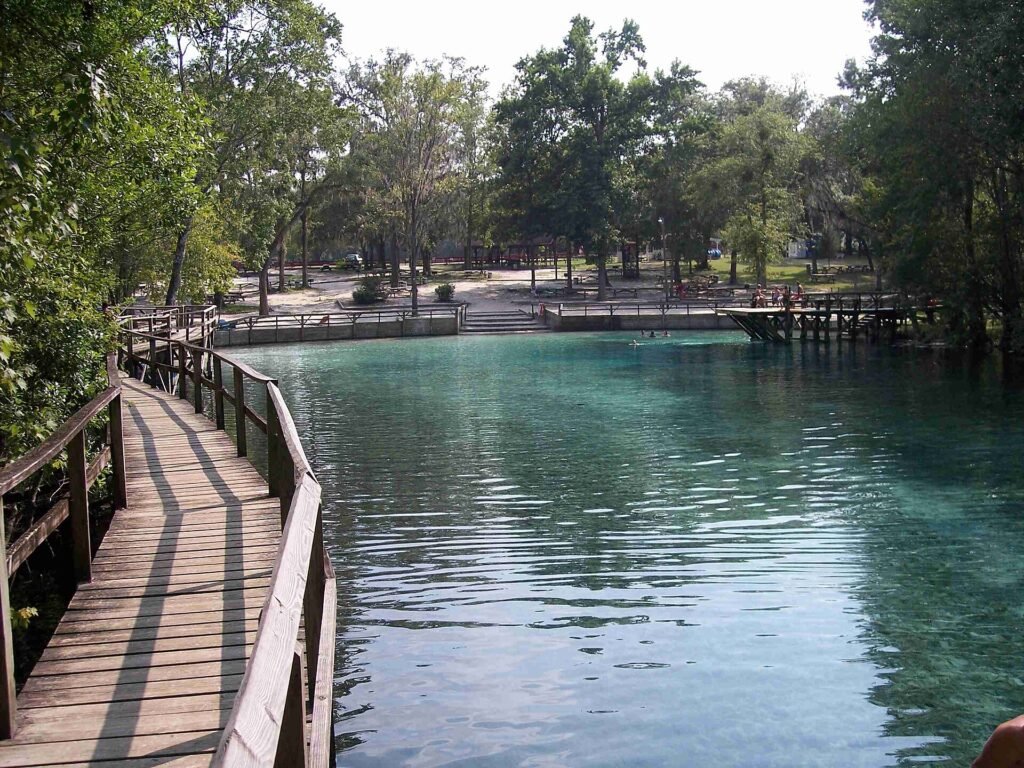
One of Florida's newest state parks (acquired in 2017), Gilchrist Blue is a startlingly clear main spring pool with a short run to the Santa Fe River. It has become the classic 'plan B' for Ichetucknee overflow — which undersells how good it is on its own.
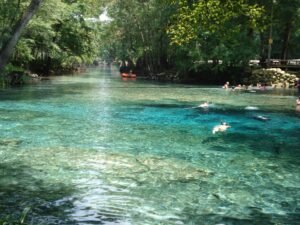
The shallow, sandy-bottomed pool makes it one of the best springs for families with small kids, and the spring run snorkel toward the river is short but genuinely beautiful.
Visiting
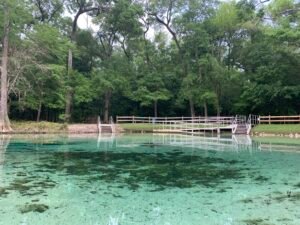
Entry is $6/vehicle. The main spring has about 50 yards of white-sand beach and a gently shelving entry that's genuinely one of the easiest for small kids on this list — no big drop-off to worry about, just a gradual walk in. There's also a diving dock on the far side where the water drops to 24 feet, so older kids and adults get a jump-in option the little ones don't have to go near.
Here's something a lot of visitors don't realize: this park actually has five named springs, not one — Gilchrist Blue is the only one you swim in, but Little Blue, Naked, Kiefer, and Johnson springs are all viewable along a 1.5-mile nature trail that also passes a genuinely impressive old-growth cypress tree.
If your kids need a break from the water or you want to stretch the day out, that trail is a nice quiet add-on nobody else on this list quite has. Compared to Ginnie six miles away, the difference in feel is immediate — standard state park rules mean no alcohol and a generally calmer atmosphere, which tends to draw more families and fewer big weekend groups.
If you've read the Ginnie writeup on this site and it sounds like more scene than you want, this is the answer just down the road. One thing that could change your whole trip: as of late October 2025, water activities including swimming and paddling were reported unavailable here due to construction renovations, with only the pavilion, picnic area, and volleyball courts open in the meantime, and rental services also paused.
As of this writing (checked Sept 25, 2026), that closure is still in effect — the state park's own page still lists no water activities, and the construction work (new swim-area entrance, a new watercraft launch, new restrooms, and an expanded campground) has no confirmed date for the water reopening; an earlier January 20, 2026 target for Phase 1-2 has come and gone. This kind of status can change once work wraps up, so before you drive out, check the Florida State Parks page directly for current status — don't assume the water is open just because it usually is.
When it's fully open, the main spring itself flows an impressive 44 million gallons a day through a quarter-mile run to the Santa Fe, and Naked Spring — one of the four viewing-only springs — is unusual in that it's accessible by a floating dock rather than just a bank.
By the numbers: Gilchrist Blue is a second-magnitude spring, discharging about 44 million gallons a day (roughly 68 cfs) when flowing normally, through a run about a quarter-mile long to the Santa Fe. Water sits at a constant 72°F year-round. High Springs is a few minutes away; Gainesville is about 25 minutes southeast, Jacksonville roughly 80 minutes northeast, and Ocala is about 50 minutes south.
When to go
Any season for the water, since it's 72°F year-round, but this park tends to fill later than some of its High Springs neighbors — reviewers note it's occasionally still had availability when others were booked out, even without weeks of advance planning. Worth checking regardless, especially around holidays.
Local tips
The walk from parking to the spring is short and flat — one of the more accessible parks on this list if you're managing a stroller or little legs that tire fast. Snorkeling is allowed in the main spring; scuba diving is not, which keeps the water calmer for families than some of the nearby dive-heavy springs. You can bring a tube and float the spring run down toward the Santa Fe River, a nice low-key alternative if the kids aren't up for a big swim.
One camper's honest note that stuck with me: the campground doesn't have a playground, so if that's important for your kids, know going in that the spring itself is the entertainment here, not a designed play area. Bring water shoes regardless of how gentle the sand entry looks — like most Florida springs, the bottom transitions to limestone in spots, and bare feet find that out the hard way eventually.
The nature trail passes a genuinely old cypress tree, estimated at 350 years, which is worth pointing out to kids as a 'this tree was already ancient before Florida was a state' kind of moment.
Rules & restrictions
No alcohol, no glass. Swimming is only in the main Gilchrist Blue Spring — the other four springs on the property are for viewing along the trail, not swimming. Dogs are welcome only at the campground, on a 6-foot leash or shorter, well-behaved and cleaned up after — not in the swim area or water. Water moccasins are present in the park in addition to alligators — stay on designated paths outside the swimming area and keep a closer eye on kids near any water's edge beyond the main spring.
Good to know
Dogs: Campground only (leashed, 6 ft) — not in the swim area or water. Season: Year-round.
Facilities
Restrooms, showers, a boardwalk along the spring run, four open-air pavilions with grills (reservable for $75, which includes a group admission discount), a small campground with 23 sites, and a concession stand. Camp sites have fire rings and sand volleyball nearby, though several campers mention the sites sit close enough together that you'll hear your neighbors.
For food beyond the park, you're in the same High Springs cluster as Ginnie and Ichetucknee — Great Outdoors Restaurant, Blue Star Grill, and Pink Flamingo Diner are all reasonable options a short drive away. RV sites include 17 dog-friendly spots with 30-amp hookups, running 25-40 feet, mostly back-in with a couple pull-through options, and a 14-night maximum stay. There's no dump station on site — the closest is at O'Leno State Park, about 8 miles away.
Wildlife you may see
Turtles, fish, and invertebrates in genuinely rich numbers in the main spring — a favorite for photographers specifically because of the clarity. Along the nature trail: great blue herons, barred owls, pileated woodpeckers, red-shouldered hawks, ibis, osprey, bald eagles, and white-tailed deer are all realistic sightings, plus channel catfish, largemouth bass, and sunfish visible in the water itself. By season: the raptors along the nature trail — osprey, bald eagles, red-shouldered hawks — are most active and easiest to spot in the cooler months; turtles and wading birds are a reliable, year-round sighting in and around the main spring regardless of season.
History & background
The state acquired this spring in 2017 from private owners who'd run it as a swimming park for generations, making it one of the newer additions to the state parks system — which shows in how uncrowded it can feel even relative to its famous neighbors.
The fuller story: Ruth B. Kirby received the spring as an engagement gift from Ed C. Wright in 1958, and after Wright died in 1969 and left her his estate, she and her family kept running it as a private swimming park for close to six decades. She's the only person known to have owned two springs that later became Florida State Parks — this one and Troy Springs. The Kirby family sold to the state in 2017, and in 2019 the park was renamed Ruth B. Kirby Gilchrist Blue Springs State Park in her honor.
Map & directions
FAQs
How much does it cost to enter Gilchrist Blue Springs?
$6 per vehicle, standard Florida state park pricing.
Is Gilchrist Blue Springs good for young children?
Yes — the main spring has a gradual, sandy entry with no steep drop-off, genuinely one of the more toddler-friendly springs on this list. There's also a deeper diving dock (24 feet) for older kids and adults who want more.
Can you swim in all five springs at Gilchrist Blue?
No — only the main Gilchrist Blue Spring is open for swimming. The other four (Little Blue, Naked, Kiefer, and Johnson) are viewing-only, reachable along the park's 1.5-mile nature trail.
Is Gilchrist Blue Springs busier than Ginnie or Ichetucknee?
Generally no — it tends to feel calmer and has occasionally had availability when neighboring parks were already full, likely because it's smaller and newer to the state park system.
Are dogs allowed at Gilchrist Blue Springs?
Only at the campground, on a leash of 6 feet or shorter and well-behaved. Pets aren't allowed in the swim area or the water, so leave the dog at the campsite if you're heading to the spring.
Can you dive at Gilchrist Blue Springs?
Snorkeling is allowed, but scuba diving is not — this keeps the main spring calmer and more family-oriented than some nearby dive-focused springs.
Is Gilchrist Blue Springs open right now?
The park itself is open (pavilion, picnic area, volleyball courts), but water activities — swimming, snorkeling, and paddling — remain closed for construction as of late September 2026. The state park's own site does not list a confirmed reopening date for the water; call ahead or check floridastateparks.org before you drive out.
Why is Gilchrist Blue Springs closed?
The park is mid-renovation: crews are building a new swim-area entrance, a new watercraft launch, new bathrooms, and an expanded campground. The work has been underway since October 2025; the park's construction page had targeted January 2026 for an early construction phase, but that date has passed and no firm date has been posted for reopening the water.
How deep is Gilchrist Blue Springs at the diving dock?
The diving dock on the far side of the main spring drops to about 24 feet, giving older kids and adults a deeper jump-in option away from the shallow, gently sloped family entry.
How many springs are in Gilchrist Blue Springs State Park?
Five: the main Gilchrist Blue Spring, which is the only one open for swimming, plus Little Blue, Naked, Kiefer, and Johnson springs, all viewable but not swimmable along the park's 1.5-mile nature trail.
Who owned Gilchrist Blue Springs before it was a state park?
Ruth B. Kirby, who received it as an engagement gift in 1958 and ran it with her family as a private swimming park for nearly 60 years. She's the only person known to have owned two springs that both became Florida State Parks — this one and Troy Springs.
When did Gilchrist Blue Springs become a state park?
The Kirby family sold the property to Florida in 2017. In 2019 it was renamed Ruth B. Kirby Gilchrist Blue Springs State Park in honor of its longtime owner.
When will Gilchrist Blue Springs' water areas reopen?
There's no confirmed date as of late September 2026. An earlier January 20, 2026 target for Phase 1-2 of the work (new swim-area entrance, watercraft launch, restrooms, expanded campground) has passed, and the state park's site still lists no water activities and no reopening date. Call the park or check floridastateparks.org before you drive out.
How much water flows out of Gilchrist Blue Springs?
About 44 million gallons a day (roughly 68 cfs) when flowing normally, making it a second-magnitude spring — smaller than nearby first-magnitude springs like Ichetucknee or Rainbow, but still a serious volume of water for a single spring pool.
Visitor photos
See this week’s shots: Instagram #gilchristbluesprings · TikTok #gilchristblue
Great for: Camping · Family-Friendly · Kayaking · Snorkeling · Swimming
.jpg)