Florida springs are wildlife habitat first and swimming holes second, and the animals you’ll see change with the season and the specific spring. Manatees show up by the hundreds in winter at a handful of springs, alligators are a year-round presence across the state’s rivers and runs, and the fish, turtles, and birds are there every time you visit if you know where to look. Here’s what you’ll actually see, and the etiquette that keeps both you and the animal safe.
Manatees
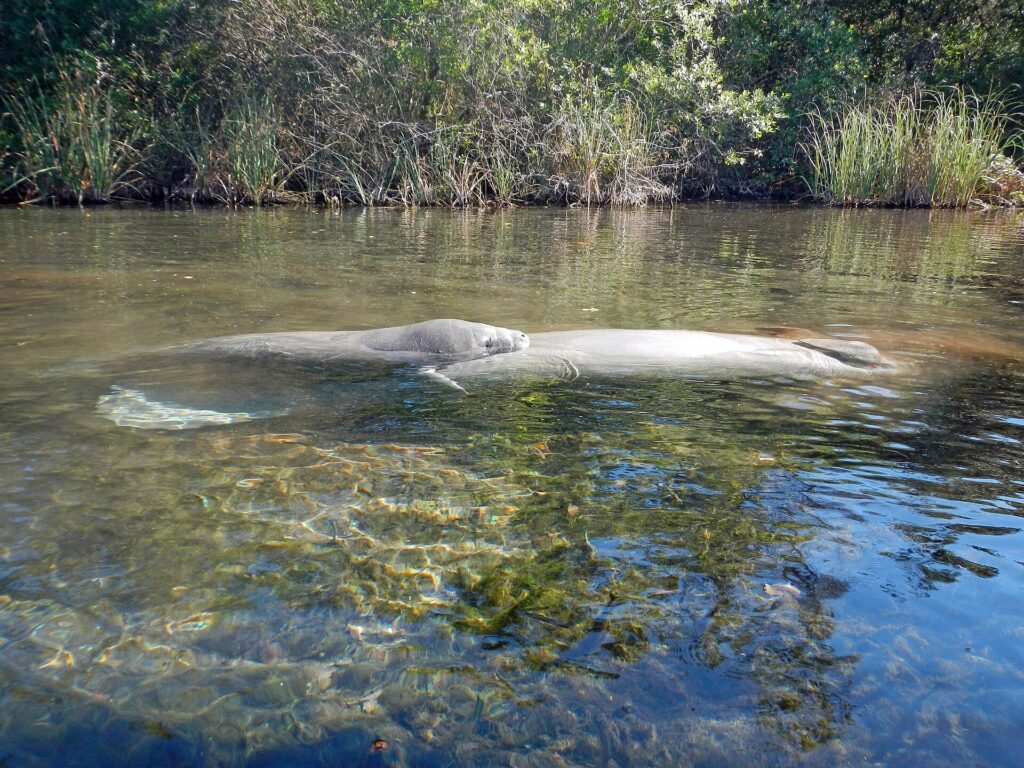
Manatees move into Florida’s warm springs from the coast every winter, typically November through March, when open-water temperatures drop below what they can tolerate — springs holding a steady 72°F become a refuge. Passive observation is the law: it’s illegal to touch, feed, chase, or in any way disturb a manatee, and enforcement is active at the well-known viewing sites.
Blue Spring is the single best-known manatee count site on the St. Johns system and regularly hosts hundreds of manatees in winter, with a boardwalk built specifically for viewing. Three Sisters Springs and Crystal River, and Homosassa Springs, are the other major concentration points on the Gulf side, along with Manatee Springs on the Suwannee. Weeki Wachee and Silver Springs also see manatees seasonally, in smaller numbers. See our manatee season guide for dates, viewing spots, and current rules, and our springs with manatees hub for the full list.
Alligators
Alligators are native and present in essentially every Florida spring run and the rivers they feed, year-round, not just in a particular season. Seeing one from a distance — basking on a bank, or a set of eyes at the surface — is normal and not cause for alarm; attacks at developed swim areas are rare. Keep distance, never feed one (illegal, and it changes their behavior toward people permanently), avoid swimming at dawn or dusk when they’re most active, and never let a dog swim in open water. The Wakulla River boat tour at Wakulla Springs is built specifically around alligator and bird viewing from a safe distance, and the Silver River at Silver Springs, the Wekiva River and Rock Springs Run near Wekiwa Springs, and Juniper Run at Juniper Springs are all reliable spots to see them from a boat, canoe, or the bank. For full behavior guidance, see our spring safety guide.
Turtles
Suwannee cooters — a freshwater turtle species largely endemic to the Suwannee and Santa Fe river systems — are a common sight basking on logs and rocks along spring runs, especially at Ichetucknee, Manatee Springs, and along the Santa Fe cluster. They startle easily and slip into the water at any close approach, so a slow paddle or a quiet float gets you a better look than a fast one.
Fish
Spring water clarity makes fish-watching one of the underrated draws of snorkeling a Florida spring. Expect schools of mullet moving through spring runs, longnose gar hovering near structure, largemouth bass and bream in the calmer pools, and striped bass in the spring-fed runs at Silver Glen Springs and Juniper Springs, both known among anglers for good striper fishing where the spring run meets the St. Johns system. None of the fish at Florida springs pose a risk to swimmers — they move away from people, not toward them.
Otters
River otters are present at many spring systems but far more often heard or glimpsed than photographed — a splash, a quick dark shape crossing a run at dawn, a slide mark on a muddy bank. Quiet, early-morning visitors have the best odds of a real sighting. They’re shy around people and not a safety concern.
Birds
Florida’s spring runs and the wetlands around them are reliable birding spots year-round. Look for limpkins (a wading bird closely tied to spring-fed rivers, with a distinctive wailing call you’ll hear before you see the bird), anhingas drying their wings on branches after diving for fish, great blue herons and little blue herons working the shallows, and ospreys circling overhead or perched on snags watching for fish. Early morning is consistently the best birding window before boat and tube traffic picks up.
Rhesus monkeys at Silver Springs
Silver Springs has a population of rhesus macaques descended from monkeys introduced to a small island in the Silver River in the 1930s for a jungle-boat tour attraction; they escaped confinement and their descendants have lived wild along the river ever since. They’re a genuine, if unusual, part of the Silver Springs experience, typically spotted from the glass-bottom boat tours or along the river. Keep distance and never attempt to feed or approach them — rhesus macaques can carry herpes B, which is rare in humans but serious, and transmission risk comes specifically from bites, scratches, or contact with bodily fluids, not from simply viewing them from a boat or trail.
Snakes
Water moccasins (cottonmouths) live in the vegetation along many spring runs, particularly tubing runs like Ichetucknee’s. They’re not aggressive toward people who leave them alone; nearly all bites happen when a hand reaches into overhanging bank vegetation rather than from an actively pursuing snake. See our safety guide for full guidance — the short version is stay in open water and don’t grab the bank.
Spring vegetation — and why you shouldn’t kick it
The eelgrass beds visible in many spring runs (Ichetucknee and Rainbow are especially known for them) aren’t just scenery — they’re critical habitat that filters the water, shelters small fish and invertebrates, and anchors the whole food web that supports everything else on this page, from fish to turtles to the birds that eat them. Kicking through eelgrass to swim, or standing on it to rest, tears it out and takes years to recover; it’s also often specifically protected by park rule. Swim over it, not through it, and use a life jacket or float to rest rather than standing on grass beds in shallow water.
What’s protected
Manatees are protected under both the federal Endangered Species Act framework and Florida law — harassment, touching, or feeding carries real penalties, and this is actively enforced at sites like Blue Spring and Three Sisters Springs. Alligators are protected from harassment and it’s illegal to feed them. Many spring systems also have specific protections on vegetation, including eelgrass beds, and on nesting birds during breeding season. When in doubt, keep hands off, keep distance, and follow posted signage at the specific park.
Best springs for wildlife by type
- Manatees: Blue Spring, Three Sisters Springs / Crystal River, Homosassa Springs, Manatee Springs
- Alligators (viewing, from a boat or safe distance): Wakulla Springs, Silver Springs, Wekiwa Springs / Rock Springs Run
- Birds: Wakulla Springs, Silver Springs, Ichetucknee Springs
- Fish and clear-water snorkeling: Ginnie Springs, Gilchrist Blue Springs (water closed for construction as of 2026), Rainbow Springs
- Turtles: Ichetucknee Springs, Manatee Springs
- Something you won’t see anywhere else: Silver Springs (rhesus macaques)
Common questions
When is the best time to see manatees at Florida springs?
November through March is the core season, with numbers typically peaking during the coldest stretches of winter when coastal water temperatures drop the most. See our manatee season guide for specifics.
Is it safe to swim where manatees are present?
Yes, but you must keep your distance and never touch, chase, or attempt to interact with a manatee — it’s both the law and the right way to avoid stressing an animal that’s already using the spring as thermal refuge. Some sites, like Blue Spring, restrict in-water access to designated swim areas specifically to protect wintering manatees.
Are the rhesus monkeys at Silver Springs dangerous?
They can carry herpes B, which is a real but low-frequency risk tied specifically to bites, scratches, or direct contact with bodily fluids — not to viewing them from a boat or trail at a normal distance. Never attempt to feed or approach them.
Will I actually see an alligator at most springs?
You’re likely to see one at some point if you visit spring runs and rivers regularly, though sightings vary by spring, time of day, and season. Developed swim areas at the spring head itself see them far less often than the runs and connecting rivers.
What should I do if I see wildlife that seems sick, injured, or in distress?
Don’t approach or attempt to help it yourself — report it to park staff on site, or to the Florida Fish and Wildlife Conservation Commission’s wildlife hotline, and let trained responders handle it.
Sources / verified against: Florida Fish and Wildlife Conservation Commission (manatee and alligator guidance), Florida State Parks (Blue Spring, Silver Springs, Wakulla Springs, Wekiwa Springs), U.S. Fish and Wildlife Service manatee protection guidance, CDC herpes B guidance for macaque exposure.