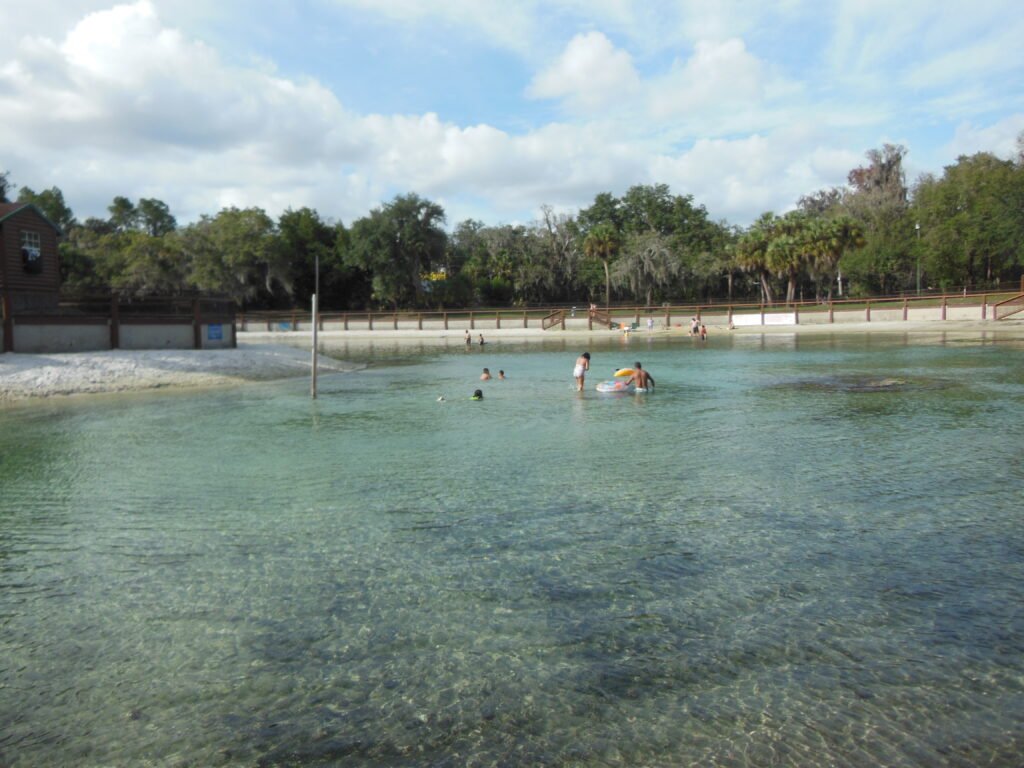
The springs that work best for toddlers and young kids aren’t the prettiest ones — they’re the ones with a gradual sandy entry, a shallow shelf you can stand in for twenty minutes, shade close to the water, and a restroom that isn’t a quarter-mile walk away. Get those four things right and a two-year-old will have a great morning. Get them wrong — a ladder into 8 feet of water, no shade, restrooms across a parking lot — and you’ll spend your visit managing a meltdown instead of swimming.
What actually matters with little kids
Before you pick a spring, run it through this checklist. It matters more than how the photos look.
- Entry type. A gradual sandy or grassy slope beats a dock, ladder, or drop-off every time. Toddlers need to walk into the water at their own pace, not be lowered off a platform into water over their head.
- A real shallow shelf. Look for springs where the shallow zone extends out several feet before the bottom drops — not a narrow lip that ends in a 10-foot boil.
- Shade near the water. Florida sun at midday is brutal on toddler skin and patience. Springs with live oak canopy right up to the swim area let you post up all day instead of retreating every 30 minutes.
- Restrooms and changing space close by. A toddler’s bladder does not care about your walk to the swim area. Springs with restrooms within sight of the water are worth choosing over ones where the bathhouse is a hike.
- Snack and gear rules. Most state parks allow coolers and picnic gear at the swim area but restrict glass containers; check current rules with the park before you pack. Some parks have loaner life jackets available at the swim area or ranger station — call ahead if you’re counting on one rather than bringing your own, since availability varies and isn’t guaranteed.
- Life jackets you bring yourself. Don’t rely on a park having your size in stock. A properly fitted USCG-approved life vest for your child’s weight is worth packing regardless.
Best picks for kids and toddlers
These are the springs where the entry, shallow water, and amenities line up for young kids. See our full springs directory for details on each.
- Kelly Park / Rock Springs — The run has a shallow, moving-water feel that’s genuinely fun for kids old enough to float on a tube, almost like a lazy river, with plenty of shallow water near the headspring for little ones to wade. Gets crowded early on summer weekends, so arrive by 9am.
- Wekiwa Springs — A gradual entry into the main swim area, sandy bottom close in, and shade from the surrounding hardwood hammock right at the water’s edge. Now requires an advance day-use reservation — book before you drive.
- Blue Spring — The boardwalk lets you preview the water and the swim area before committing, and the designated swim zone is calmer than the main spring run. Great for families who want to look before they wade in.
- Gilchrist Blue Springs — Normally has a shallow, sandy swim area near the headspring that’s forgiving for toddlers, with deeper water nearby for older kids who want to snorkel. Its water areas are closed for construction renovations as of 2026 with no confirmed reopening date, so it’s off the list for now — Wekiwa Springs and Salt Springs above and below are the closer substitutes for the same kind of gentle entry.
- Lithia Springs — The developed swim area has a county-pool-like feel — contained, shallow near the edges, with lifeguards on duty during posted hours in season. One of the more toddler-manageable springs in the Tampa area.
- Ponce de Leon Springs — A small, calm pool with a gentle entry and a shaded picnic area right next to the water. Low-key and easy to supervise.
- Salt Springs — Shallow water extends well out from shore, and the developed swim area (USFS, ~$14.50/person) has restrooms and a store close by.
- De Leon Springs — Less about swimming depth and more about the whole outing: the spring run is swimmable and shallow near the dock, and the on-site pancake house (make-your-own griddles) turns a meltdown-prone lunch stop into the highlight of the trip.
- Weeki Wachee Springs — The mermaid show is built for toddlers who’d rather watch than swim, and the seasonal Buccaneer Bay water park (river tubing, shallow pools) gives you a backup plan if the main spring’s current feels like too much for a young kid that day.
Skip these with toddlers
Beautiful springs, wrong fit for little ones — save them for when your kids are older and can swim confidently.
- Devil’s Den — Entry is down a stairway into a sinkhole with real depth right away; this is a snorkeling and diving destination, not a wading spot.
- Ginnie Springs — The headspring and the “Ballroom” and “Devil’s Eye” areas are deep bowls with abrupt drop-offs close to the bank. Beautiful for older kids and adults, not a toddler spot.
- Juniper Run at Juniper Springs — Gorgeous paddle, but it’s a narrow, current-driven run best suited to kids who can already paddle and swim, not toddlers wading.
Timing: capacity, closures, and naps
Several parks — Rainbow Springs and Wekiwa Springs among them — now require advance day-use reservations, and popular parks close their gates entirely once the lot fills, sometimes by mid-morning on summer weekends. See our reservations and capacity guide before you plan a day trip.
Build your visit around your kid’s schedule, not the other way around. Arriving right at gate-open (usually 8am) gets you parking, shade, and calm water before crowds and boat/tube traffic pick up. If your toddler naps, plan to be back at the car or under a shade tent by early afternoon — that’s also when the parking lot fills and the water gets choppiest from other visitors.
The cold-water thing for kids
Florida springs run about 72°F year-round, which feels shockingly cold to a small kid used to bathwater or even a backyard pool, especially on entry. Expect protest for the first minute or two — most kids adjust and don’t want to leave twenty minutes later, but don’t force it if a toddler is shivering or has blue lips. Bring a rash guard or wetsuit top for kids who run cold, and a warm towel and dry clothes staged right at the water’s edge so you’re not carrying a shivering toddler across a hot parking lot. For more on why the water is always that temperature, see our 72°F guide.
Gear list for a spring day with little kids
- USCG-approved life vest sized to your child’s actual weight (don’t rely on a park loaner)
- Water shoes — spring bottoms are often sandy, but roots, shell, and limestone show up without warning
- Rash guard or thin wetsuit top for kids sensitive to cold water
- Reef-safe sunscreen, reapplied — water reflection intensifies sun exposure
- Pop-up shade tent for springs without much natural canopy over the swim area
- A dry towel and full change of clothes staged at your spot, not left in the car
- Snacks that don’t need refrigeration and water in a spill-proof container
- A pool noodle or small float — many kids relax into the cold water faster with something to hold onto
Common questions
Do any Florida springs have lifeguards?
A few developed swim areas post lifeguards during specific hours in peak season — Lithia Springs is one — but most Florida springs, including most state park swim areas, have no lifeguard at all. Assume you are your child’s only lifeguard everywhere unless a park specifically posts otherwise, and check with the park for current hours.
What age is right for a first spring visit?
Any age, if you pick the right spring — a gradual, shallow entry works for an infant being held or a toddler just learning to stand in water. The spring matters more than the age; a deep-bowl spring like Ginnie isn’t right for a toddler at any age, while Kelly Park or Wekiwa can work for a one-year-old.
Are the springs too cold for babies and toddlers?
72°F is cold by pool standards but it’s not dangerous for brief exposure with a healthy child — watch for shivering or blue lips as your cue to warm up, not the clock. Many toddlers protest for the first minute and then don’t want to get out.
Can we bring a stroller?
Most state park paths from parking lot to swim area are paved or hard-packed and stroller-friendly, but check the specific park — some, like Devil’s Den, involve stairs. Call ahead if a stroller is essential to your plan.
Is it worth paying for a spring with a reservation requirement just for a toddler day?
Yes, if the alternative is arriving to a closed gate. Wekiwa and Rainbow both require booking ahead in 2026 — reserve before you load the car, especially on weekends.
Sources / verified against: Florida State Parks (Wekiwa Springs, Rainbow Springs, Blue Spring, Gilchrist Blue Springs, Ponce de Leon Springs, De Leon Springs, Devil’s Den), Orange County Parks (Kelly Park / Rock Springs), U.S. Forest Service Ocala National Forest (Salt Springs, Juniper Springs), Hillsborough County Parks (Lithia Springs), Weeki Wachee Springs State Park.