Some Florida springs are genuinely workable for wheelchair users and people with limited mobility — boardwalks, paved paths, boat tours, and underwater observatories that need no water entry at all — while others involve stairs, ladders, or uneven natural terrain that no amount of planning gets around. This guide is about telling those two categories apart honestly, so you’re not finding out at the trailhead.
What “accessible” actually means at a spring
Accessibility at a spring breaks into layers that don’t automatically come together: getting to the park (parking, restrooms), getting to the water’s edge (boardwalks, paved paths, trails), and getting into the water itself (ramps, zero-entry sand, or a ladder you have to climb down). A park can be excellent on the first two and still have no real way into the water, and vice versa. We’ve organized this guide around that distinction, because “accessible” as a blanket word hides more than it tells you.
State park standards: parking and restrooms
Florida State Parks generally provide ADA-standard accessible parking spaces and accessible restroom facilities at their main developed areas — this is a baseline you can count on at most of the state parks on our site (Blue Spring, Manatee Springs, Wekiwa, Rainbow, Wakulla, and others), since it’s required infrastructure at state-run facilities. That said, “accessible parking near the entrance” doesn’t tell you anything about the terrain between the lot and the water, which is where the real variation shows up. Always check the specific park’s accessibility page or call ahead to confirm current conditions, since renovations and storm damage can temporarily take a ramp or restroom out of service.
Boardwalks and paved paths that work well
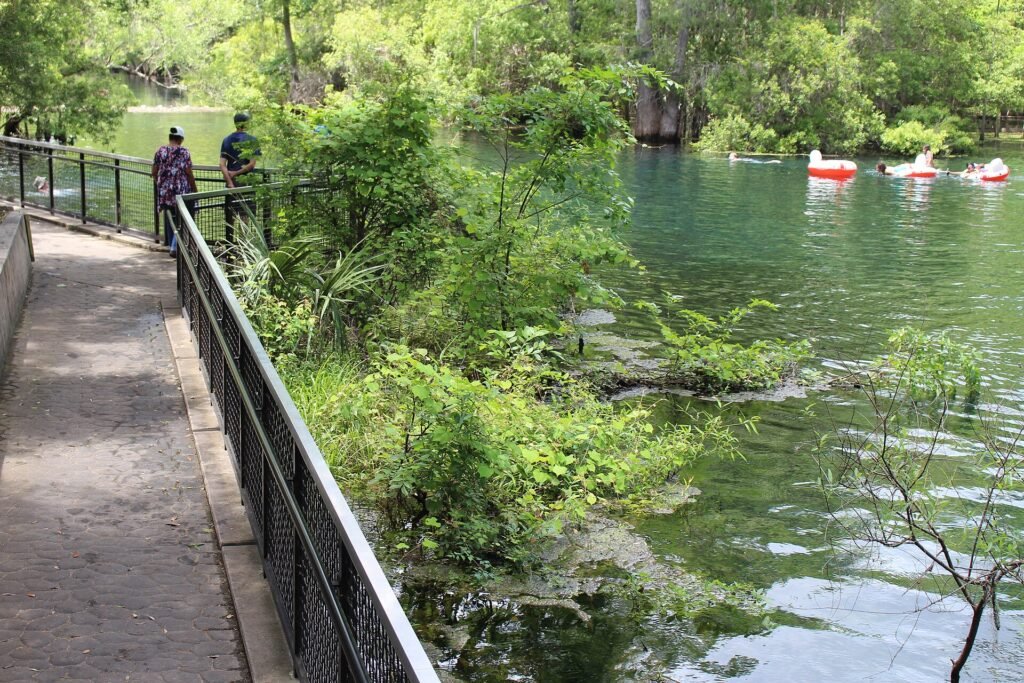
Blue Spring State Park has a long boardwalk running the length of the spring run from the day-use area down toward the St. Johns River, and it’s one of the best wheelchair-friendly wildlife-viewing experiences at any Florida spring — during manatee season you can roll the entire boardwalk and see manatees from multiple vantage points without needing to leave a paved or decked surface.
Wakulla Springs‘s main visitor experience is built around the lodge and the narrated boat tour, both of which are accessible without any water entry — the boat tour is arguably the best way to see this spring regardless of mobility, since swimming isn’t the point here anyway (Wakulla’s water isn’t open for general swimming near the boil).
Silver Springs‘s glass-bottom boat tours work the same way — a fully seated, no-water-entry way to see one of the clearest, largest springs in the state, departing from a dock area near the main park facilities.
Homosassa Springs combines an underwater observatory — a below-water-level viewing chamber you can reach without any water entry — with a tram that shuttles visitors through the wildlife park, making this one of the more complete no-water-entry spring experiences on our site.
Manatee Springs has a boardwalk running from the spring pool area out along the spring run to the Suwannee River, giving you a real look at the run and river confluence without needing to navigate the swim area itself.
Rainbow Springs‘s headsprings area has paved paths connecting the main overlooks and garden areas, though be aware the terrain gets steep in places as it descends toward the water — this is a partially accessible site rather than a fully flat one, and the steepest sections toward the swimming area may not be manageable for all wheelchair users. Call the park to ask specifically about the grade near the swim area before you commit to a visit built around water access there.
Water entry: ramps, sand, and where it’s genuinely flat
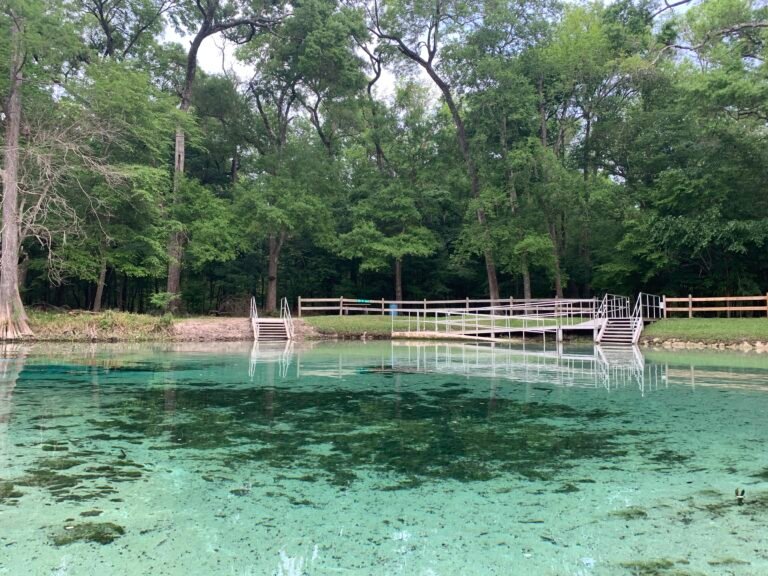
A short list of springs where the actual entry into the water is relatively flat rather than a stair or ladder descent: Wekiwa Springs has a sand-bottom swimming area with a gradual entry; Salt Springs has a similarly gradual, sandy swim area; and Gilchrist Blue Springs normally has sandy entry points rather than a hard drop into deep water, though its water areas are closed for construction as of 2026, so this note applies once it reopens rather than right now. None of these are true accessible water-entry ramps with rails built specifically for wheelchair transfer, as far as we’re confident — they’re simply flatter, more gradual natural entries than the alternative. If a specific ADA-compliant water-entry ramp exists at a park we haven’t confirmed, call that park directly; we’d rather send you to make one phone call than overstate what we know.
Some parks provide beach wheelchairs or water-access chairs on request — we’re not confident enough in which specific parks currently stock this equipment to name them here, since availability changes and isn’t consistently advertised. Call the park directly and ask specifically whether they have a beach wheelchair or all-terrain wheelchair available for loan, and whether it needs to be reserved in advance.
Where stairs or ladders block real access
Be aware of these before you plan a trip around swimming: Devil’s Den requires descending a staircase down into the sinkhole to reach the water — there’s no ramp alternative, and the cavern setting makes this a hard no for anyone who can’t manage stairs. Ginnie Springs‘s famous limestone “bowls” and several of its access points involve stepping down natural, uneven rock rather than a graded path, and while the main swim area has an easier bank entry, the bowls themselves are not accessible. Madison Blue Spring‘s main water access involves a staircase down to the spring pool, with no alternate flat entry that we’re aware of.
Tubing and tram accessibility
Ichetucknee’s shuttle trams move tubers between the takeout and launch points, but we’re not confident about current wheelchair-lift equipment on those trams or about how tubing itself works for visitors with limited mobility — getting in and out of a tube at a natural riverbank launch is a different challenge than a boardwalk visit. Call the park directly before planning a tubing trip around accessibility needs, and ask specifically about tram boarding and launch-point terrain.
Disability pass discounts
Florida residents with qualifying disabilities can be eligible for reduced or waived entry fees at Florida State Parks under the state’s disabled veteran and disability discount programs — the specifics (which programs qualify, what documentation is required) are set by the state park system and can change, so confirm current eligibility and required paperwork directly with Florida State Parks or the specific park before you go, rather than assuming a general rule applies everywhere, including at privately run springs like Ginnie or Devil’s Den, which set their own pricing independent of state programs.
Call-first checklist
Before driving to any spring with accessibility needs in mind, call the park and ask:
- Is there a paved or hard-packed path from the parking area to the water’s edge, and what’s the grade like in the steepest section?
- Is there a ramp or gradual entry into the water, or is entry by stairs, ladder, or a drop-off bank?
- Do you have a beach wheelchair or all-terrain wheelchair available, and does it need to be reserved in advance?
- Are the accessible restrooms and parking currently in service, or under repair?
- If we’re planning around a boat tour, tram, or boardwalk, what’s the current schedule and is advance reservation required?
- Do you offer a disability discount on entry fees, and what documentation do you need to see?
Parks are generally glad to answer these in detail — a five-minute call before you drive saves a wasted trip far more reliably than any website description, since terrain, equipment availability, and even which paths are currently open can change with storm damage, construction, or seasonal maintenance.
Common questions
Which single spring is the best all-around choice for a wheelchair user who wants to see wildlife without needing water entry?
Blue Spring State Park — the boardwalk runs the full length of the spring run, manatee viewing is excellent in season, and none of it requires leaving a decked surface.
Are any Florida springs set up with an actual ADA water-entry ramp with rails?
We’re not confident enough in specific current installations to name one here. If this matters for your trip, call ahead and ask the park directly whether they have a dedicated accessible water-entry ramp, since this is exactly the kind of detail that changes with park improvements and isn’t something we’d want to get wrong.
Do state parks allow service animals in swim areas where pets are otherwise restricted?
Service animals are generally permitted under ADA rules even where pets are restricted, but confirm specifics with the individual park, since swim-area rules can vary and a call ahead avoids any confusion at the gate.
Is Rainbow Springs’ headspring area a good choice for limited mobility?
Partially — the main paths are paved, but the terrain gets steep toward the water in places. It’s worth a call to ask specifically about the grade near the swim area before building a trip around it.
What’s the most reliable way to confirm accessibility before a long drive?
A phone call to the park, same-day if possible, asking the specific questions in our call-first checklist above — general website descriptions and secondhand reviews are the least reliable source for something this trip-specific.
Sources / verified against: Florida State Parks general accessibility standards and individual park websites for Blue Spring State Park, Wakulla Springs State Park, Silver Springs State Park, Homosassa Springs Wildlife State Park, Manatee Springs State Park, Rainbow Springs State Park, Wekiwa Springs State Park, Salt Springs (Ocala National Forest), Gilchrist Blue Springs State Park, Devil’s Den, Ginnie Springs, and Madison Blue Spring State Park.