Tubing a Florida spring run means renting or bringing an inner tube, riding a tram or shuttle to a put-in point upstream, and floating downstream on 72°F water back to where you started. The whole loop — tram, float, walk back to the car — usually takes two to three hours, and the float itself is almost always shorter than people expect.
How a tube run actually works
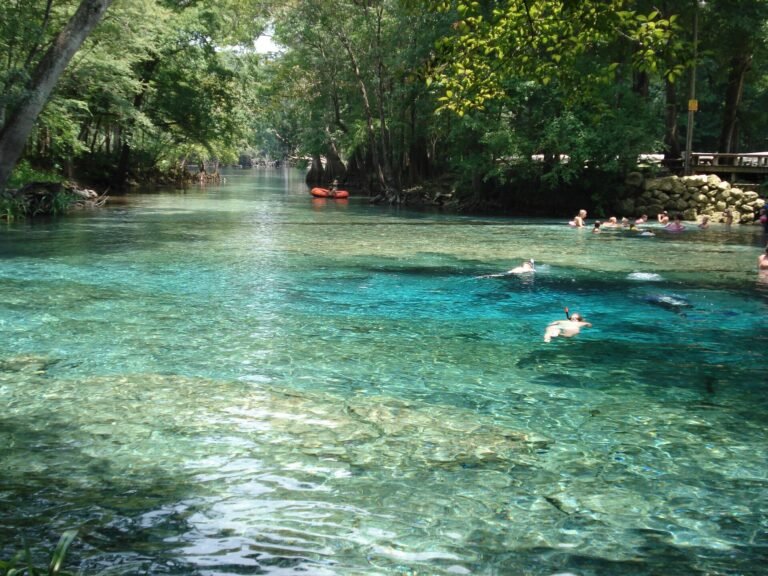
Nearly every spring-run tubing operation follows the same shape: you park, you rent a tube (or carry your own), you either walk or ride a tram/shuttle to the put-in, and you float back down to the take-out near the parking lot. The current does the work — you’re not paddling, you’re drifting, occasionally kicking off the bottom or a bank to stay off the edges. At the springhead itself the water is coldest and clearest; a quarter mile downstream it’s warmed a couple of degrees by the sun and mixed with tannic tributary water, so don’t judge the whole run by the first five minutes.
The tram or shuttle is the part first-timers stress about and shouldn’t. At Ichetucknee Springs, the tram line at the south entrance looks long at 9am on a July Saturday, but it loads fast — trams run continuously and the line moves faster than it looks from the back. Don’t skip breakfast to beat it; get there at opening instead.
The main tubing runs
As of 2026, the Ichetucknee’s Midpoint launch is closed, so all tubing starts at Dampier’s Landing (the south entrance) — the shorter run, about 1.5 hours by tube depending on water level. The North launch upstream is kayak/canoe only now, capped at 750 paddlers a day, so it is not a tubing option this season; read the details in our 2026 Ichetucknee tubing guide before you go.
The Rainbow River is the other classic. Tubers put in at KP Hole County Park downstream of the state park headsprings and float a few miles back to KP Hole; KP Hole rents tubes and runs its own shuttle, and it’s the easiest way to do the Rainbow without owning gear. Note that Rainbow Springs State Park itself (the headsprings and swimming area) now requires an advance day-use reservation — KP Hole is a separate access point downstream and has its own rules, so check which one you’re actually booking.
Ginnie Springs and the adjoining Santa Fe River cluster offer river tubing too — Ginnie sells tube rentals on-site and the Santa Fe current carries you past several spring boils. This is a private park with an entry fee ($25/adult March–October, $20/adult November–February as of 2026), and day passes stop being sold at 3pm and expire at sunset, so plan your float for the morning.
At Kelly Park (Rock Springs Run) near Apopka, tubing is walk-in only — there’s no tram. You carry your tube upstream along the bank trail to the top of the run and float back down to the park’s main area, which is part of the experience; the walk is short but do it in water shoes, not flip-flops. Kelly Park fills its parking lot by mid-morning on summer weekends, so this is one where arriving at opening genuinely matters.
Blue Spring State Park on the St. Johns is a swimming and snorkeling spring, not a tubing run — the spring run is closed to swimming entirely in winter when manatees are present, and even in warm months we wouldn’t call it a tubing destination the way Ichetucknee or the Rainbow are. If tubing is the goal, this isn’t the spring to pick.
Rentals vs. bringing your own tube
Every major tubing spot rents tubes on-site or immediately outside the gate, and for a first visit that’s the easier call — you don’t have to inflate, deflate, or find room for a tube in the car. Rental tubes typically come in a couple of sizes (single-rider and larger “two-person” tubes that fit an adult and small kid, or two adults loosely). If you bring your own, oversized tubes — the kind built for a cooler built in — are fine on wide runs like the Rainbow but awkward on narrower stretches of the Ichetucknee where the channel pinches and overhangs get low.
Glass containers are banned on every spring run we know of, no exceptions, and it’s enforced. Disposable single-use plastic containers are also restricted or banned outright at several parks (Ichetucknee among them) — bring reusable bottles and cans instead of anything you’re planning to leave behind or that could shatter underfoot. Read the specific rules for wherever you’re going before you pack the cooler.
Float times and how to time your trip
| Run | Approx. float time | Shuttle/tram | Notes |
|---|---|---|---|
| Ichetucknee (Dampier’s Landing) | ~1–1.5 hrs | Tram back to entrance | Only tubing launch in 2026 |
| Rainbow River (KP Hole) | 2–3 hrs | KP Hole shuttle | Separate from headsprings reservation |
| Ginnie/Santa Fe | 1–2 hrs | Walk or park shuttle | Day passes stop at 3pm |
| Rock Springs (Kelly Park) | ~45 min | None — walk upstream | Fills early on summer weekends |
Float times swing with water level and how much you’re paddling versus drifting, so treat these as a range, not a promise. The single best piece of timing advice we have: arrive at opening on a weekday if you can get one. A Tuesday morning at Ichetucknee in June feels like a private spring; the same spot on a July Saturday afternoon means a packed lot, a long walk from overflow parking, and a tram queue that — even moving quickly — eats into your float time.
What to wear and what to bring
- Water shoes or old sneakers — the bottom near put-ins and take-outs is often rocky or has submerged roots, and Kelly Park’s walk-up requires real footwear
- A swimsuit under quick-dry clothes; 72°F water feels cold going in even on a 95°F day, and you’ll want a layer for the tram ride back if there’s any breeze
- A strap or leash to clip a dry bag or cooler tube to your tube so you’re not chasing it downstream
- Reef-safe or no sunscreen at all in the clearest spring pools — heavy sunscreen sheen is visible in the water and some parks discourage it right at the boil
- A hat and sunglasses with a retainer strap — you will flip backward off a tube at some point
- Cash or a card for tube rental deposits, which some outfitters still handle old-school
Kids and non-swimmers
Life jackets (properly fitted, Coast Guard-approved) are the right call for young kids and for anyone who isn’t a confident swimmer, even on a lazy run — spring runs have a real current, and being pinned briefly against a strainer or bank happens even in “easy” sections. Most rental operations stock kids’ life jackets alongside tubes; ask when you check out gear rather than assuming you’re covered. On Kelly Park’s Rock Springs Run, the current runs faster and colder near the top of the run than it looks from the bank, which surprises people who choose it as a “gentle” first spring for a young child — it’s a fun run, just not the mellowest one.
What people get wrong
- Showing up at 11am on a summer Saturday expecting an easy parking spot — arrive within the first hour of opening or go on a weekday
- Bringing glass or single-use plastic and getting turned away at the gate
- Assuming the Ichetucknee Midpoint launch is still open in 2026 — it isn’t; Dampier’s Landing is your only tubing option this season
- Skipping a life jacket for a “non-swimmer who’ll just float” — currents move tubes faster than people expect near spring boils and narrow channels
- Underestimating how cold the water feels the second time you get in after warming up on the bank — it’s genuinely colder feeling on re-entry, not just your imagination
Common questions
Can I tube at Ichetucknee’s North launch in 2026?
No. The North launch is kayak and canoe only in 2026 and capped at 750 paddlers per day. Tubing this season starts at Dampier’s Landing, the shorter southern run.
Do I need my own tube, or can I rent one there?
You can rent at every major tubing destination we cover — Ichetucknee’s outside vendors, KP Hole for the Rainbow, and Ginnie on-site. Renting is simpler for a first trip; bring your own only if you already own one you like and have room to transport it.
Are dogs allowed on the tube runs?
No — dogs are not allowed on the Ichetucknee during tubing season. Most Florida state parks allow leashed dogs in the park itself but not in swim or tubing areas; check the specific spring’s rules before bringing a pet.
How cold is the water really?
Florida springs run about 72°F year-round, which feels refreshing on a 95°F July day and genuinely cold on a 65°F December morning. Read more in our 72°F explainer.
What if it rained recently — will the water still be clear?
Spring boils themselves usually stay clear, but river runs fed by tannic tributaries can go dark and tea-colored after heavy rain. Check our tannic water guide before you drive out.
Sources / verified against: Ichetucknee Springs State Park, Rainbow Springs State Park and KP Hole County Park, Ginnie Springs Outdoors, Kelly Park/Rock Springs (Orange County Parks), Blue Spring State Park — floridastateparks.org and each park’s own site.