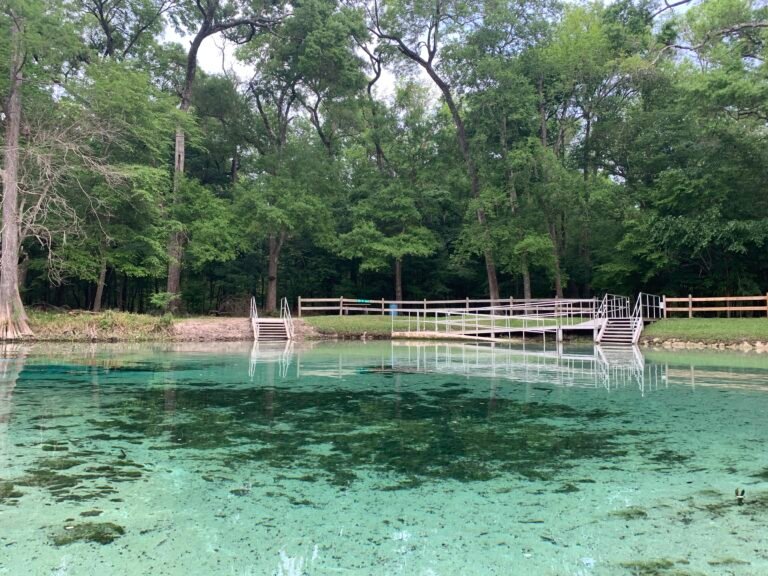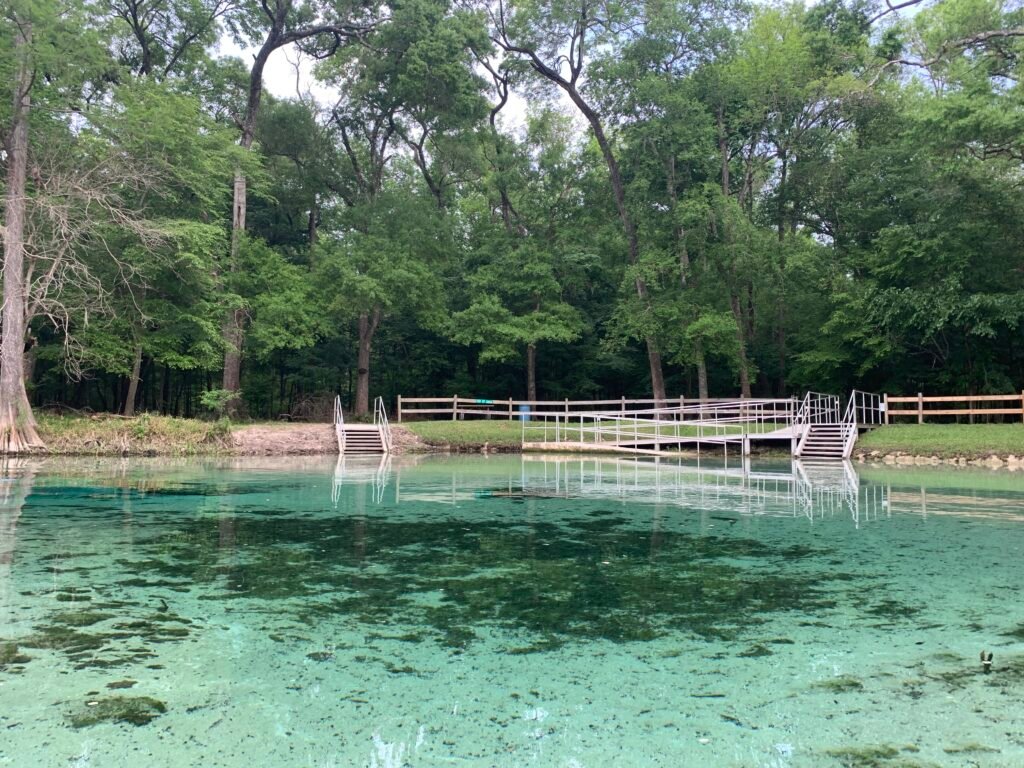
The single most common disappointment we hear about from Florida spring trips isn’t a closure or a crowd — it’s arriving to find the water murky or brown instead of the glass-clear blue in every photo. This is almost always explainable, and almost always avoidable with a five-minute check before you leave the house.
Two kinds of clarity, and why they’re different
A spring’s own water — the boil itself, where it emerges from the aquifer — is essentially always clear. That water has been filtered through limestone and sand for months or years underground, and it comes out that way regardless of the weather above ground. But many springs don’t stay isolated pools; they flow into a run that connects to a river, and it’s that connection that creates the clarity problem. When a connecting river rises after heavy rain, its darker, tannic water can back upstream into the spring run and basin, mixing with or even overwhelming the clear spring discharge. The spring itself hasn’t gotten murkier — river water has pushed into it.
The springs where this is a real, documented risk
Several springs we cover explicitly flag this as a known condition, not a rare fluke. Little River Springs is described as “very sensitive” to Suwannee River levels — when the river rises, tannic water backs into the spring and visibility can drop for days or weeks at a time, and the spring page notes there have been fatalities at the site’s cave system, making respecting the cavern boundary and checking conditions first doubly important. Rum Island Spring carries the same warning for the Santa Fe River, and can flood outright when the Santa Fe runs high. Madison Blue Spring‘s startling blue basin turns tannic when the Withlacoochee River backflows into it — common enough that the park closes the swim area specifically when this happens. Troy Spring and Lafayette Blue Springs, both on the Suwannee, carry the same river-dependent clarity note. Wakulla Springs is flagged as having genuinely variable clarity — worth checking before visiting specifically for the swim.
By contrast, spring-fed pools with less direct river connection or larger flow volumes — Ichetucknee, Ginnie, Rainbow — tend to hold their clarity more reliably, though even these aren’t entirely immune during unusually heavy or prolonged rain.
Why this connects to the rainy season
Florida’s rainy season runs roughly June through September, which is exactly when tannic backflow is most likely across every river-dependent spring on this list. It’s a genuine irony of Florida spring planning: summer is when most people want to visit, and summer is also when clarity risk is highest at river-connected springs. Fall and winter, once rainfall tapers off, tend to bring the clearest water at exactly these sensitive sites — a detail we cover in more depth in what changes at Florida springs as summer turns to fall.
What “tannic” actually looks like, and why it isn’t dangerous
Tannic water gets its color from dissolved organic compounds — tannins — leaching out of decaying leaves, cypress needles, and other plant matter upstream, the same natural process that gives sweet tea its color. It’s a completely natural condition, not pollution, and it isn’t unsafe to swim in. It just isn’t what most people picture when they picture a Florida spring, and if visibility and photos are the point of your trip, a tannic day at a normally clear spring can be a genuine letdown after a long drive.
How to check before you drive
The most reliable way to avoid a wasted trip is checking recent conditions rather than assuming a spring looks like its official photos. Our conditions page notes known clarity risks for the springs where we’ve documented the pattern, and we update it as we re-verify each one. Beyond that, a quick search for recent visitor photos or reviews from the last few days — rather than the professional photography most park websites use — is often the fastest real-world check. If a spring’s own page or recent visitor posts mention rain in the area over the preceding week, treat clarity as a real question mark rather than an assumption.
A simple rule of thumb
If you’re choosing between two springs and clarity is genuinely important to your trip — a snorkeling day, underwater photos, showing kids the classic clear-blue Florida spring experience — favor spring-boil-heavy sites like Ichetucknee’s Blue Hole or Ginnie’s main spring over river-run-dependent sites like Little River or Rum Island, especially in summer or right after a rainy stretch. And if a river-dependent spring is the one you really want to see, plan for the drier months when possible; the same spring that’s disappointing in August can be spectacular in November.
Which springs this applies to
Beyond the springs already named above, a few more in our directory carry the same river-dependent clarity pattern worth knowing about before you drive:
- Suwannee Springs — a historic sulphur spring on the Suwannee itself, where water clarity depends heavily on the river’s level; after heavy rain the river can rise into the spring and cloud it entirely, while dry spells let it pool clear inside the old 1890s bath-house walls.
- Little River Springs — 125 acres on the Suwannee, with an underwater cave system divers have explored since the 1960s; the spring itself is described as very sensitive to river levels, and high water backs tannic color into the basin for days or weeks at a stretch.
- Rum Island Spring — on the Santa Fe River, where the clear spring water visibly meets the tannic river water at the surface on a normal day, and the spring can flood outright when the Santa Fe runs high.
- Troy Spring — also Suwannee-dependent for clarity; the site’s clearest conditions come in late morning during dry months, when sunlight reaches the deep basin and the river is running low.
- Fanning Springs — part of the same broader Suwannee spring system, and a minority of visitors report seasonal flooding can affect access to some areas after heavy rain, on top of any clarity change.
Frequently asked questions
How long does a spring stay tannic after a big rain?
It depends on how high the connecting river rose and how long it takes to recede, but our own notes on sites like Little River Springs describe visibility dropping for days or weeks at a time after a significant rise — not just for the day of the storm itself.
Are tannic springs safe to swim in?
Yes. Tannic color comes from natural plant tannins, the same compounds that color sweet tea, and it isn’t a sign of contamination or unsafe water. It’s purely a visibility and photography issue, not a safety one.
Can I tell from home whether a spring is tannic right now?
Not with certainty, but a good proxy is checking whether it’s rained heavily in that spring’s watershed over the past week or two, then checking our conditions page and recent visitor photos for that specific spring before you commit to the drive.
Sources / verified against: our own conditions log and spring pages for Little River Springs, Rum Island Spring, Madison Blue Spring, Troy Spring, Lafayette Blue Springs, and Wakulla Springs, cross-checked against general tannic-water background from Florida water management district and USGS river-water-quality resources.