Should you go?
Lafayette Blue’s party trick is geological: a natural limestone bridge divides the spring pool, so you swim beneath a rock arch in vivid blue water beside the Suwannee.
It is deep-country Florida — the town of Mayo is one of the state’s quietest county seats — which means even summer Saturdays feel manageable.
Is it worth it? For the limestone bridge alone, yes — it’s a genuinely unusual feature you won’t find at most other springs on this list, and the low visitor numbers make it one of the more peaceful stops in North Florida. Just watch the Suwannee’s level before a special trip, since high water tans the pool the same way it does at every other Suwannee-adjacent spring.
Visiting
Entry is $5/vehicle (standard state park rate). This first-magnitude spring is spanned by a natural limestone bridge — a genuinely distinctive geological feature not found at most other Florida springs. Riverside cabins and a campground pair with picnic areas shaded by oaks draped in Spanish moss. Like all Suwannee-adjacent springs, high river levels push tannic water into the pool. For camping: Riverside cabins and a campground on the Suwannee, built around a striking natural limestone bridge over the spring. Entry is $5/vehicle on the honor system.
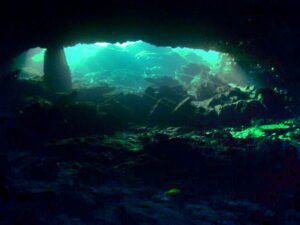
This is genuinely one of the quieter, more secluded springs on this list — more than one visitor reports having the entire place to themselves on a weekday. Certified divers can explore a substantial 12,000-foot underwater cave system here, well beyond what casual snorkelers see at the surface.
The park's cabins sleep 8 and run about $103/night, walking distance from the spring; walk-in tent camping (no RV access) runs around $10/night with power and water at each site. A one-mile loop trail circles part of the property for anyone wanting to stretch their legs between swims, and the park doubles well as a base for exploring the Suwannee River Wilderness Trail nearby.
Florida State Parks' own hours-and-fees page confirms $5 per vehicle carrying two to eight people, $4 for a single-occupant vehicle, and $2 for pedestrians, bicyclists, or extra passengers, paid on an honor-box system with exact change required; the park is open 8am to sundown, 365 days a year. As a first-magnitude spring, Lafayette Blue can discharge up to 168 million gallons of water a day, according to sourced figures — one of the higher-volume springs on this list.
By the numbers: Lafayette Blue is one of only 33 first-magnitude springs in Florida, discharging up to 168 million gallons a day, with water holding a constant 72°F year-round. The spring itself is compact — two connected pools split by the limestone bridge, ringed by roughly 30 picnic tables, with a very short run that spills into the Suwannee over a small natural waterfall. It was a local swimming hole long before it became a state park. Mayo, the county seat, sits at the park entrance; from there it's roughly 65 miles (about 1 hour 15 minutes) to Gainesville, about 75 miles (1 hour 20 minutes) to Tallahassee, and about 115 miles (just over 2 hours) to Jacksonville.
When to go
Dry-weather months for the clearest water, since high Suwannee levels directly affect this spring's clarity. Weekdays for the best shot at having it mostly to yourself.
Local tips
Visitors consistently describe having the park nearly to themselves, even on a weekend — more than one reviewer specifically mentions having the place entirely to themselves on a weekday, a rarity for a first-magnitude Florida spring. Cabin guests rave about the quality: reviews call them well-appointed and comfortable, though bath mats aren't provided and the kitchens are only lightly stocked, so bring your own paper products and any specific cookware you'll want.
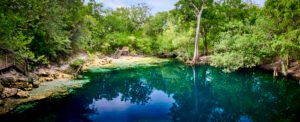
Despite the name, several visitors note the spring itself often looks green rather than true blue, though it stays clear even when tinted — set expectations before you arrive chasing a postcard-blue photo. There's no real beach area, so bring your own chairs if you plan to sit at the water's edge rather than on a towel in the grass.
Food options are thin — one reviewer found nothing of note for miles around, though another found decent restaurants in Mayo itself, so pack a cooler to be safe either way. High water on the Suwannee occasionally floods the park entirely; one visitor arrived to find the whole area underwater, so check river levels before a special trip during or after heavy rain. Rangers get consistent praise for being helpful, and the facilities are described as clean throughout.
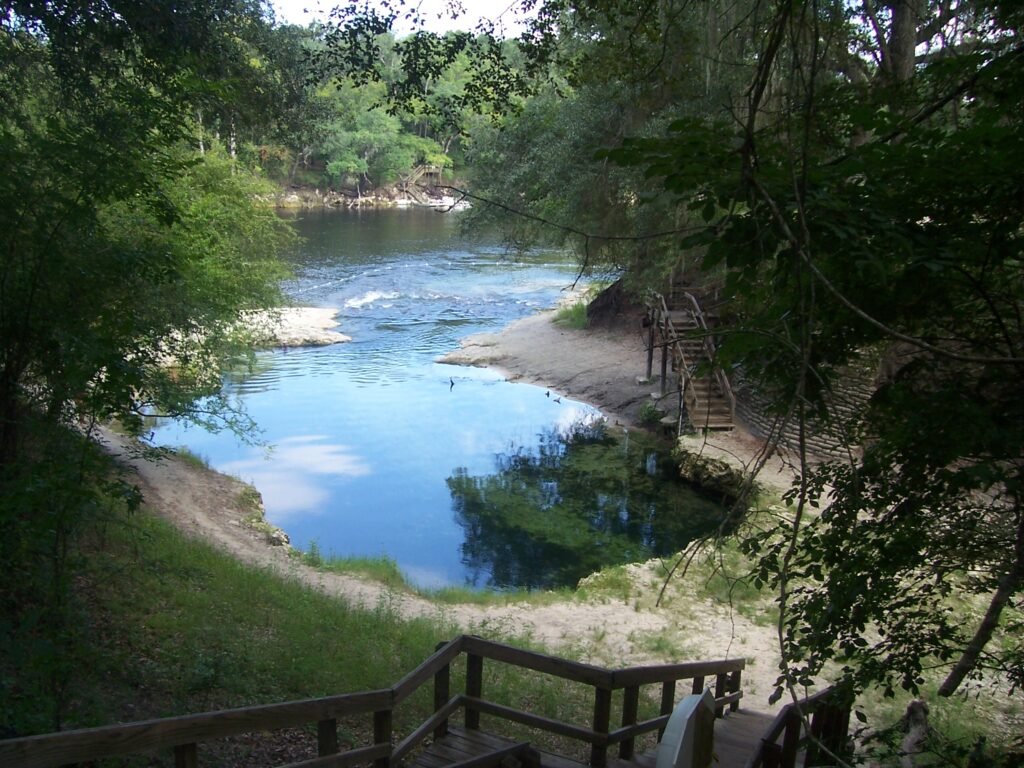
Watch for Gulf sturgeon if you paddle the adjacent Suwannee — these fish run 150 to 220 pounds and leap clear of the water with real force; boaters have been injured colliding with one mid-air, so wear a life jacket on the river regardless of your swimming ability. The park's riverside cabins are two-bedroom houses on stilts with wraparound screened porches and full kitchens, queen plus twin beds; one cabin has elevator access for wheelchair users. Beyond the swim, an easy one-mile loop trail plus the half-mile Green Sink Trail give you a short walk through the woods, and stairs plus a ramp lead down to an observation deck at the limestone bridge for anyone who can't manage the stairs.
Rules & restrictions
Leashed dogs are welcome throughout the park, except inside the cabins. Cave diving requires full certification for the deeper passages, and divers must register at the ranger station before entering the underwater passages, diving in teams of at least two fully certified cave divers.
Good to know
Dogs: Park yes, not in water. Season: Year-round.
Facilities
Restrooms and showers, five screened sleeping pavilions with ceiling fans and outlets (accommodating 6-8 people each), a shared tent camping area with fire pits and picnic tables, and riverside cabins. Facilities are consistently described as clean and well-maintained, some reviewers noting they feel brand new. Nearest towns for supplies or a meal out: Mayo is 8 miles, Live Oak 27 miles, and Fort White (near the Ichetucknee cluster) about 39 miles if you want to combine trips.
An ADA-accessible ramp leads down to an observation deck at the limestone bridge for visitors who can't use the stairs, and one riverside cabin has elevator access.
Wildlife you may see
Typical Suwannee River wildlife — fish visible in the clear spring water, otters and wading birds along the river, with the natural limestone bridge formation adding a genuinely interesting geological feature to snorkel around.
Gulf sturgeon are a genuine hazard as well as a spectacle on the adjacent Suwannee — paddlers report seeing them jump repeatedly on a single trip, and their size (150-220 lbs) means a collision can injure a boater, not just startle one.
History & background
Karst geology is on full display here — a natural limestone bridge spans two connected pools when water levels are normal, a visible reminder of the porous limestone landscape that creates Florida's springs in the first place.
Cave divers have mapped more than two miles of passages into the Floridan aquifer beneath the spring; entry is restricted to teams of at least two fully certified cave divers, who must register at the ranger station before descending. The spring was a local swimming hole for the surrounding community long before Florida acquired the land and made it a state park.
Map & directions
FAQs
How much does Lafayette Blue Springs cost?
$5 per vehicle, paid on the honor system.
Are there cabins at Lafayette Blue Springs?
Yes — riverside cabins sleeping 8, walking distance from the spring, around $103/night, though without TV or wifi.
Is Lafayette Blue Springs crowded?
Generally no — it's one of the more secluded springs on this list, with visitors regularly reporting having the place nearly to themselves on weekdays.
Can you cave dive at Lafayette Blue Springs?
Yes, for fully certified divers — the system extends roughly 12,000 feet underwater, well beyond what casual snorkelers see.
How much does Lafayette Blue Springs cost exactly?
Per Florida State Parks' official fee page, $5 for a vehicle with 2–8 occupants, $4 for a single-occupant vehicle, and $2 for pedestrians, bicyclists, or extra passengers — paid via honor box with exact change.
How much water flows from Lafayette Blue Spring?
Up to 168 million gallons a day according to sourced figures, consistent with its first-magnitude classification — one of the higher-volume springs on this list.
What are Lafayette Blue Springs' hours?
8am to sundown, 365 days a year, per Florida State Parks' official hours page — no seasonal changes.
Is Lafayette Blue Springs actually blue?
Not always — several visitors describe the water looking green rather than true blue, though it stays clear. The color shifts with light, season, and Suwannee River levels.
Is there a beach at Lafayette Blue Springs?
No real sandy beach — bring your own chairs if you want to sit at the water's edge rather than relying on the park to provide seating.
Is there cell service at Lafayette Blue Springs?
Coverage is inconsistent in this rural part of Lafayette County — expect a weak signal in the park and don't count on a strong connection, so treat it as a break from your phone.
Are there alligators at Lafayette Blue Springs?
Alligators live throughout the Suwannee River spring system, including here, though sightings in the swimming area itself are uncommon. Keep your distance and avoid swimming at dusk or after dark.
How cold does Lafayette Blue Springs feel?
The water holds steady at 72°F year-round, which feels bracing on a hot summer day and genuinely cold in winter — most visitors need a few minutes to acclimate.
Can you bring your own kayak or tube to Lafayette Blue Springs?
Yes — there's a boat ramp and canoe/kayak launch on site, and no separate reservation is required to bring your own boat, unlike some busier springs.
Are there Gulf sturgeon at Lafayette Blue Springs?
Yes, in the adjacent Suwannee River — these large fish (150-220 lbs) leap from the water and have injured boaters on impact, so wear a life jacket if you paddle beyond the spring itself.
Visitor photos
See this week’s shots: Instagram #lafayettebluesprings · TikTok #lafayetteblue
Great for: Camping · Family-Friendly · Snorkeling · Swimming