Should you go?
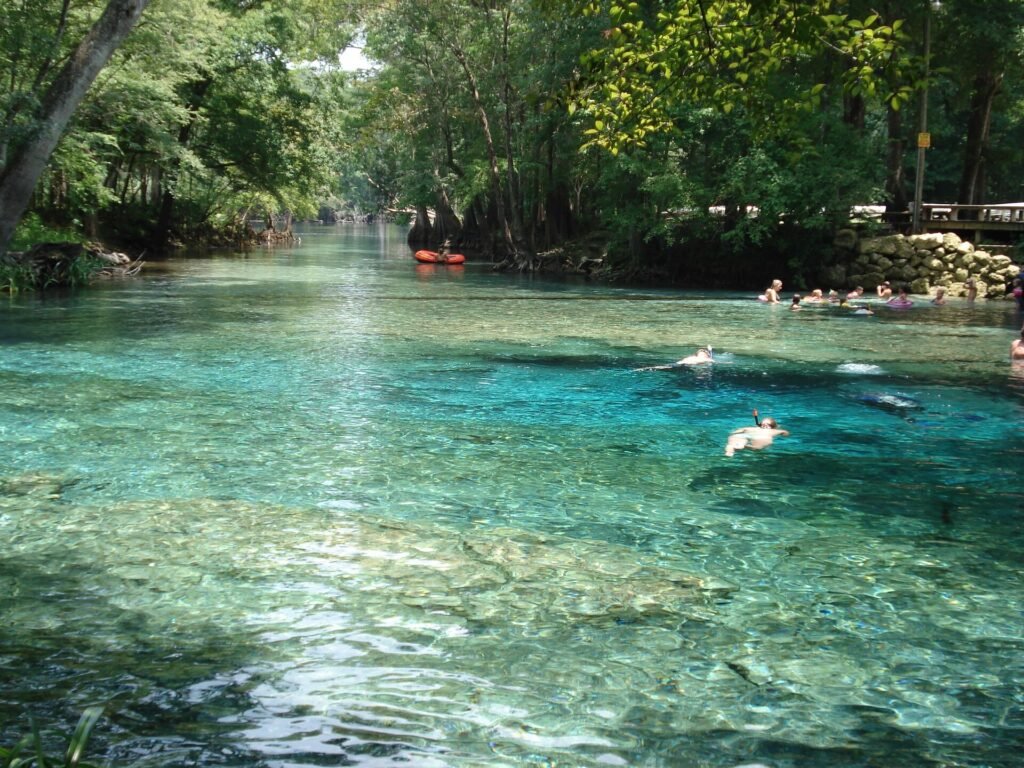
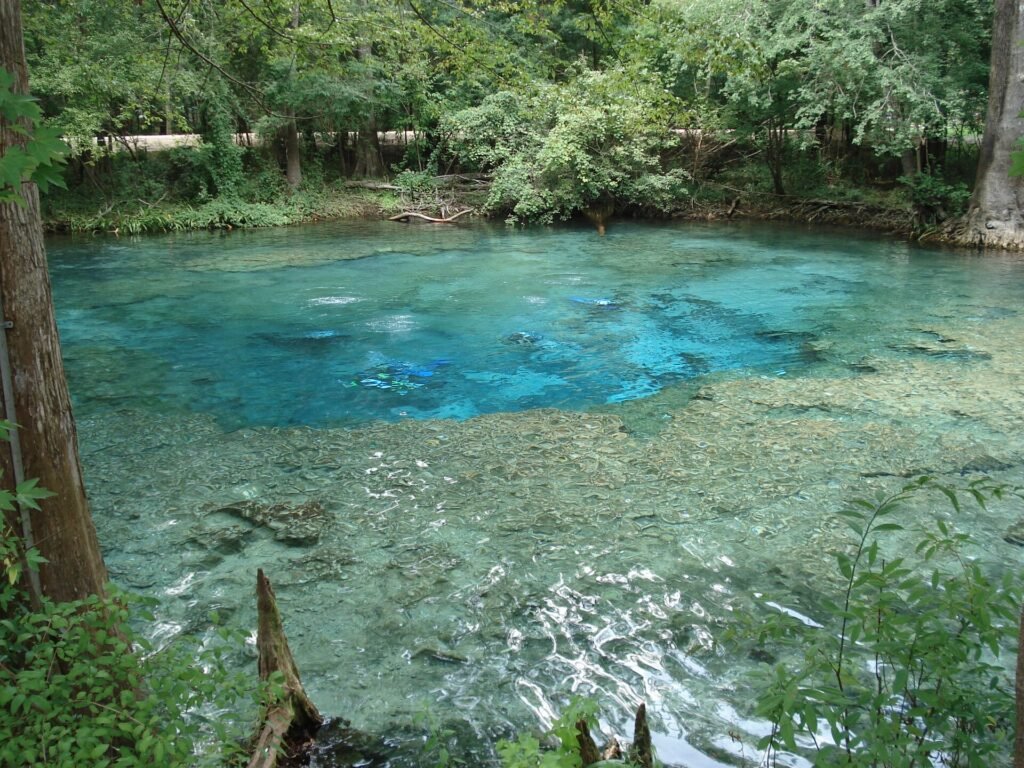
Ginnie is the famous private park on the Santa Fe River: seven springs, some of the clearest water in the state, and cave systems that draw divers from around the world. Jacques Cousteau reportedly called this water 'visibility forever,' and on a good day it earns the line.
The vibe is the tradeoff. Ginnie allows alcohol and draws a lively weekend crowd of tubers and campers, which makes it either the most fun spring in Florida or the one to avoid, depending on what you came for.
Visiting
Day admission runs $25/adult in season (March-October) and $20/adult off-season (November-February) per the park's own admission page, and passes stop selling at 3pm. If you're bringing the whole crew, know upfront that camping here isn't cheap — it's private land, not a state park, and runs $40/adult/night in season ($30 off-season), so a family of five camping a weekend adds up fast.
This is the one where I'll be straight with you: Ginnie is genuinely beautiful and has more to do than almost anywhere else on this list — seven distinct springs, a dive shop, riverside camping — but it's also where Florida's spring-day-turns-into-party-scene reputation comes from. As of April 21, 2026, a new alcohol policy confines drinking to inside your own campsite boundaries only — no more carrying a drink to the springs, picnic areas, or trails — which is a real, confirmed change from the looser atmosphere of past years.
With younger kids, I'd lean toward a weekday visit regardless, since weekends still draw a livelier crowd. The Ballroom cavern is open to any certified open-water diver with lights allowed — a genuinely rare setup that makes it a favorite first cavern dive — while the Devil's Spring System nearby is cave-certified only.
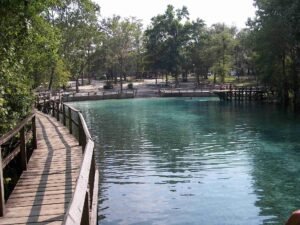
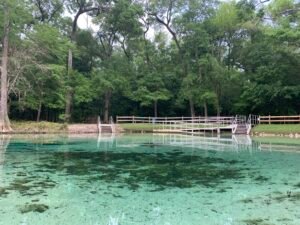
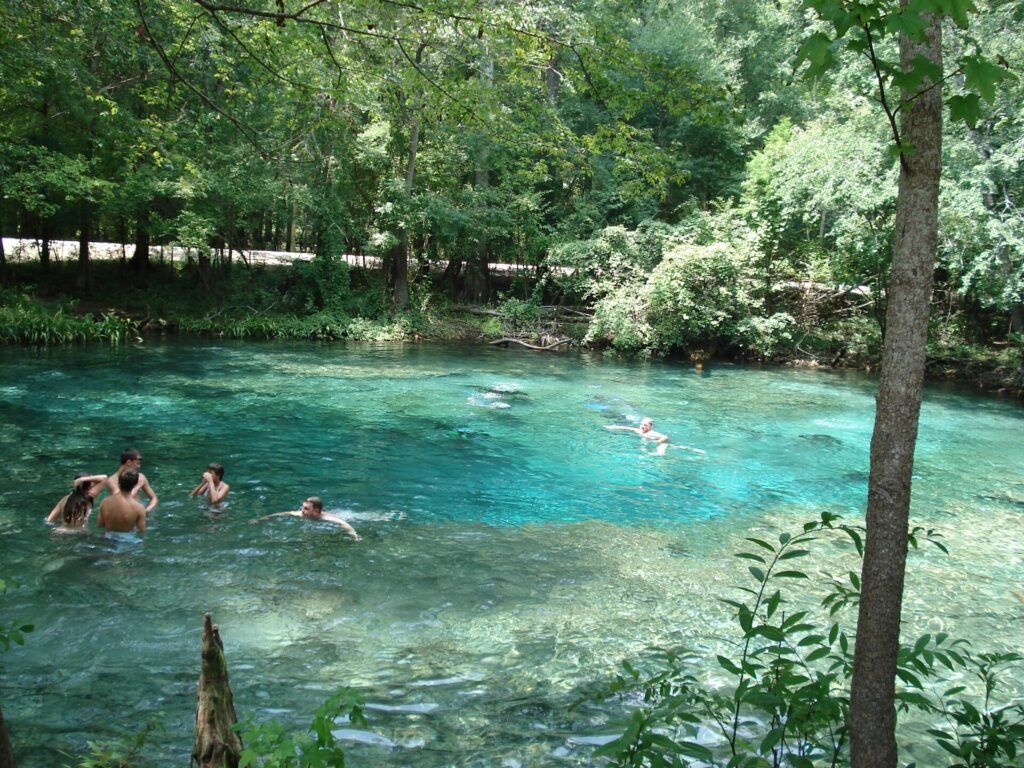
What surprises first-time visitors most is the sheer size of the property — this isn't one spring you park next to, it's seven distinct springs spread across acreage you actually walk or drive between, so plan your day around which ones you want to hit rather than assuming you'll see everything in an afternoon. The seven named springs are Ginnie, Devil's Eye, Devil's Ear, Little Devil, Dogwood, Twin, and June Spring — worth knowing the names, since staff and other visitors will reference them directly when giving directions. The main Ginnie Spring itself has a wide, sandy, gently sloping entry that's easy for kids, while some of the others (Devil's Eye, Devil's Ear) are narrower and more dramatic with stronger current — worth knowing which is which before you let younger kids wander off toward the wrong one.
(The park's own admission page currently lists $25/adult in season, Mar-Oct, and $20/adult off-season, Nov-Feb, with kids 4-12 at $6/$5 and 3-and-under free — confirm the exact rate for your visit dates before you go, since the older ~$20-flat figure has since moved.) Diving fees follow the same seasonal split: the park's site lists $36 for a certified diver's day pass and $28 for a full cave-certified diver, with an annual cave dive pass at $440 for regulars.
Camping is priced per person per night rather than per site — $40/adult in season, $30 off-season, $10/$8 for kids 4-12 — and that nightly rate already includes park admission for the day, so you're not paying twice. Water-and-electric sites add a flat $15 utility fee and carry a two-night minimum from April through September (three nights on major holidays); the primitive riverfront tent sites are first-come-first-served with no reservation and no minimum stay.
By the numbers: Ginnie is a second-magnitude spring system averaging about 40 cubic feet per second of flow across its vents (USGS, 1995-2019 average). The main Ginnie Spring bowl runs about 90 feet across and 12 feet deep over a sandy limestone bottom; the outflow itself is roughly 35 feet wide and 3 feet deep before it reaches the Santa Fe River floodplain about 500 feet downstream. Water holds at 72°F year-round. High Springs sits about 25 miles (35 minutes) from Gainesville, roughly 70 miles (1 hour 20 minutes) from Jacksonville, and about 130 miles (2 hours 20 minutes) from Orlando.
When to go
Weekdays, any season, if a calm family visit is the goal — this is the spring where day-of-week matters more than time-of-year. Regular season (roughly spring through fall) for full pricing and full crowds; off-season for a quieter, cheaper visit if the weather cooperates.
Local tips
Springs here range from a manageable 8-10 feet down to 25-30 in the deeper spots, so know which spring you're at before letting kids swim unsupervised. One thing that surprises first-timers: absolutely no pets are allowed, not even service animals — people get turned away at the gate regularly, so don't plan around bringing the dog. Go on a weekday if you can.
Reviews are consistent that the difference between a Tuesday and a Saturday here is night and day — a calm family float versus a genuinely loud scene into the night. Trip reports and forum posts describe the same logistics over and over: the parking areas nearest Ginnie Spring itself and the Ballroom cavern fill first on summer weekends, so arriving right at the 8am open (not mid-morning) buys you the closest spot and the clearest, least-stirred-up water before the crowd gets in.
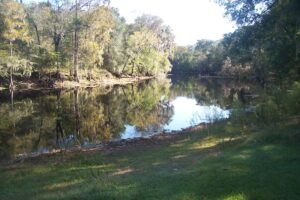
Several reviewers specifically call out the walk between the far lots and the water as longer than people expect for a first visit, so a wagon or cart for coolers and gear is a recurring recommendation, not a luxury. Visitors who've tubed the adjoining Santa Fe River consistently note it's a different experience from the spring itself — tannic, dark, and much warmer than the spring water, so don't expect the same clarity once you drift off the spring run and onto the river proper.
Divers describe the Ballroom as an easy, confidence-building first cavern swim thanks to the ambient light from the entrance, while first-timers who wander toward Devil's Eye or Devil's Ear without cave training consistently get turned back by staff — the boundary is enforced, not a suggestion. Regulars say the general store gets picked over by afternoon on busy weekends, so buy ice and drinks on the way in rather than counting on restocking mid-day, and that cell signal is spotty enough across the property that a paper map or a screenshot of the campground layout saves real frustration.
Rules & restrictions
No pets of any kind, including service animals — this is enforced at the gate. Cave diving requires full cave certification, verified on site. Alcohol policy (effective April 2026): may only be opened and consumed within your reserved campsite/primitive site boundaries — no glass bottles anywhere on the property, no open containers in the springs, swim areas, picnic zones, trails, parking, or any shared public space. Public intoxication isn't allowed, quiet hours run midnight-8am, and violations mean immediate disposal and possible removal without refund.
Keep your car pass — losing it means paying again on the way out.
Good to know
Dogs: NO pets — not even service animals (strictly enforced). Season: Year-round.
Facilities
Full private-park setup: showers and bathhouses (reviewers consistently say these are clean and well-kept), a dive shop with air fills and rentals, a general store, and camping with waterfront sites available first-come-first-served. Picnic areas and grills throughout. There's a small deli right on site (The Ginnie Deli, attached to the on-property gas station) for basics and quick food, so you're not totally stuck if you don't want to leave.
For a proper meal after, Pink Flamingo Diner is about 10 miles out and doubles as entertainment — full diner menu, a full bar, and an 18-hole mini-golf course that's a nice way to burn off restless kid energy post-swim. High Springs proper, about 15 minutes away, has more options including Great Outdoors Restaurant and Bambi's Café.
Per the park's own camp page, water-and-electric sites (123 of them, across from the General Store) come with a picnic table and grill and access to a dump station, though none have sewer hookups; the wooded tent sites, some of them right on the river, are more basic — grills and tables, a subset with running water — and don't take reservations at all, so those go to whoever shows up first.
Ginnie's on-site general store rents tubes, kayaks, and paddleboards for visitors who don't bring their own gear. Several local outfitters just outside the gate also rent equipment and run shuttle service, useful if you want to float a longer stretch of the Santa Fe and get picked up downstream instead of paddling back upstream against the current. The closest other springs on this list — Poe Springs, Rum Island Spring, Little River Springs, and Ichetucknee Springs — are all within about 20 minutes, so it's easy to pair a Ginnie morning with an afternoon at one of them.
Wildlife you may see
Turtles and bass in the springs themselves; the wider Santa Fe brings otters, mullet, and the occasional alligator well downstream of where people swim. Watch for gators if you wander off the main swim areas toward the river.
History & background
Jacques Cousteau filmed here in the 1970s and reportedly called the water 'gin clear' — the description that's followed the springs ever since. The Devil's system below has been explored and mapped by cave divers for decades and remains one of the sport's serious proving grounds.
The Wray family has privately owned the property since 1971 and opened it to the public in 1976; the park opened to the scuba diving community in the mid-1990s, which built its national reputation as a serious cave-diving destination. In 2021, Nestlé was granted a permit to draw up to 1.1 million gallons a day from the aquifer near the springs — a permit that's drawn ongoing local pushback over its effect on Santa Fe River flows.
Map & directions
FAQs
Do I need to be certified to dive at Ginnie Springs?
Open-water snorkeling and swimming need no certification. Diving the caverns and the Devil's cave system requires appropriate certification, checked at the office.
Does Ginnie Springs allow alcohol?
Yes, but under a new policy effective April 21, 2026: alcohol is allowed only within your reserved campsite or primitive-site boundaries. No glass bottles are allowed anywhere on the property, and no open containers are allowed in the springs, swim areas, picnic zones, trails, parking, or other shared public spaces. Public intoxication is prohibited and quiet hours run midnight to 8am; violations can mean immediate disposal of alcohol and possible removal without refund.
How much does Ginnie Springs cost?
Per the park's own admission page, adult day entry is $25 in season (March-October) and $20 off-season (November-February); kids 4-12 are $6/$5 by season and children 3 and under are free. Diving day passes run $36 for a certified diver and $28 for a full cave-certified diver.
Is Ginnie Springs good for families with young kids?
It can be, but go in with realistic expectations. Reviewers consistently note it suits families with older kids or those prioritizing water activities over a quiet, secluded feel better than it suits toddlers — the main spring itself is easy and shallow-entry, but the campground can be lively, especially on weekends.
How many springs are at Ginnie Springs?
Seven named springs across the property — Ginnie, Devil's Eye, Devil's Ear, Little Devil, Dogwood, Twin, and June Spring — ranging from wide and gentle (the main Ginnie Spring) to narrow and swift (the Devil's system), plus riverfront access to the Santa Fe.
How much does camping cost at Ginnie Springs?
Camping is priced per person per night: $40/adult and $10/child (4-12) in season (March-October), $30/adult and $8/child off-season (November-February), per the park's own camping page. That rate already includes the day's park admission. Water-and-electric sites add a flat $15 utility fee and require a two-night minimum from April through September.
Can you tube the Santa Fe River from Ginnie Springs?
Yes, Ginnie sits on the Santa Fe River and many visitors combine a swim at the spring with a float on the river itself — but the river is tannic and noticeably warmer than the spring water, so don't expect the same clarity once you leave the spring run. The on-site store and outside outfitters both rent tubes if you don't bring your own.
Do you need cave certification to dive the Ballroom at Ginnie Springs?
No — the Ballroom cavern is open to any certified open-water diver with a dive light, which makes it one of the more accessible cavern dives in the state. The adjacent Devil's Spring System, however, is restricted to cave-certified divers only, and staff enforce that boundary.
Is there cell service at Ginnie Springs?
Coverage is spotty across the property, especially near the river and the farther springs. Several regulars recommend screenshotting the campground map or admission info ahead of time rather than counting on a signal once you're inside.
How cold does the water feel at Ginnie Springs?
At a steady 72°F, most people find it brisk on first entry but comfortable once they're in, especially in Florida's summer heat. It's noticeably colder than the tannic Santa Fe River water you'll hit if you float off the spring run.
Are there alligators at Ginnie Springs?
Alligators are occasionally seen in the wider Santa Fe River, well downstream of the main swim areas, but they're uncommon in the springs themselves. Stay alert if you wander toward the river on foot or by tube.
Visitor photos
See this week’s shots: Instagram #ginniesprings · TikTok #ginniesprings
Great for: Camping · Kayaking · Scuba Diving · Snorkeling · Tubing