Cavern diving stays in daylight on a permanent guideline and is open to any certified open-water diver; true cave diving means leaving the light behind through a restriction, and it demands full cave certification with no exceptions. Air fills and rental gear are only guaranteed at the private resorts — everywhere else, bring your own tanks.
At a glance
| Spring | Cavern vs cave | Certification | Entry / dive fee | Notes |
|---|---|---|---|---|
| Ginnie Springs | Ballroom cavern (open) + Devil’s cave system | Open water for Ballroom; full cave for Devil’s | $25/adult season, $20 off-season | No diving some holiday weekends |
| Devil’s Den | Domed prehistoric cavern, no open water | Open Water certification required | $48 dive / $30 snorkel | 50+ ft deep, no flotation devices |
| Blue Grotto Dive Resort | Lit 100-ft cavern + separate cave | Open water for cavern; full cave for cave | $61 dive / $23 snorkel | Air bell at 30ft; avoid weekend midday classes |
| Morrison Springs | Cavern to ~90ft; deeper cave sealed | Open water for cavern | $4/car | Closes after heavy rain (water quality) |
| Troy Spring | Open spring, no cave/cavern diving | Open water only; no solo, no lights | $5/vehicle | Civil War wreck, protected site, no touching |
| Madison Blue Spring | 26,000+ ft mapped cave system | Full cave required, no solo | $5/vehicle | Frequent 10am–3pm weekend closures |
| Wes Skiles Peacock Springs State Park | Orange Grove Sink open; Peacock I/III restricted | Cavern/cave certification for Peacock I & III | $4/vehicle | No DPVs, no solo diving |
| Alexander Springs | Small cavern, strong outflow vent | Open water | $14.50/person | Only scuba site in Ocala National Forest |
| Manatee Springs | Catfish Hotel cave sink | Full cave required | $6/vehicle | Swim area closes in winter (manatees) |
| Jackson Blue Spring | Caves along Merritt’s Mill Pond | Cave-certified, county permit | $4/person (kayak/canoe rental separate, ~$10–15/hr) | Swim area seasonal, typically summer |
| Vortex Spring | 50-ft basin, cavern entrance | Posted per-site requirements | $15 adult / $10 child day-use, diving separate | Camping on site; weekdays quieter |
| Little River Springs | Serious cave system below | Full cave | $5/vehicle | — |
How to choose
Certification determines access, not experience level or price. Open water gets you into basins and lit caverns with permanent guidelines — Ginnie’s Ballroom, Blue Grotto, Devil’s Den, and Alexander Springs all work on this alone. Full cave certification is the only thing that gets you past a restriction into Madison Blue Spring’s mapped passage, Peacock Springs’ Peacock I and III entrances, the Devil’s system beyond Ginnie’s cavern line, or Little River’s cave system — no operator here will bend that rule, and these systems have taken trained and untrained divers alike.
No solo diving is the rule at nearly every site, and several prohibit lights, DPVs, or diving on certain days. Check clarity before you drive — river-fed springs (Morrison, Troy, Little River, Manatee) turn tannic and murky after heavy rain. New to spring diving? Start at Alexander, the Ginnie Ballroom, or Blue Grotto.
Common questions
Do I need to be cave-certified to dive any Florida spring?
No — several sites, including Ginnie’s Ballroom, Blue Grotto, and Alexander Springs, allow certified open-water divers into lit caverns with permanent guidelines. True cave systems, like the Devil’s system past the cavern line, Madison Blue Spring, and Peacock Springs, require full cave certification and redundant gear.
Can I bring my own tanks, or do I need to rent?
It depends on the site. Ginnie Springs, Blue Grotto, Devil’s Den, and Vortex Spring run full dive shops with air fills and rentals on site. State park and Forest Service springs — Troy Spring, Madison Blue Spring, Peacock Springs, Manatee Springs, and Alexander Springs — expect you to arrive self-sufficient.
Why do some springs close to divers after rain?
River-fed springs like Morrison Springs and Manatee Springs pull tannic water in when the nearby river rises. Morrison specifically closes for water quality until it clears, so check conditions before driving out.
What does a Florida spring dive actually cost?
Day rates range from $4-6 for a state park vehicle entry (Troy Spring, Madison Blue Spring, Peacock Springs) up to $48-61 per diver at private resorts like Devil’s Den and Blue Grotto. Ginnie Springs runs $20-25 per adult depending on season, and Alexander Springs charges roughly $14.50 per person through its Forest Service concessionaire.
Florida's springs are the freshwater diving capital of the world — gin-clear 72°F water, prehistoric caverns, a Civil War shipwreck, and some of the longest underwater cave systems on earth. But dive sites here range from beginner-friendly basins to lethal cave systems, and the difference matters enormously. Here is what each spring offers, what certification it demands, and what it honestly costs.
Fees below were verified against official and operator sources during our last review and are dated in each spring's full guide; a few private and county rates are flagged to confirm. Dive rules and closures change — always check with the site before you go.
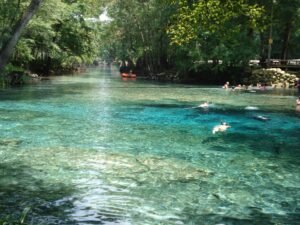
Why here: The most accessible cavern dive in Florida — the famous Ginnie Ballroom is open to any certified open-water diver, with lights allowed, making it the place divers cut their teeth before going deeper.
Ginnie is a private park (~$20/adult, verified) with a full dive operation: air fills, rentals, and a dive shop on site. The Ballroom cavern is huge, well-lit by its own openings, and open to all certified divers — a rare combination that makes it the classic first cavern dive. The separate Devil's Spring System (Devil's Eye, Devil's Ear, Little Devil) is cave-certified-only, and the deeper cave has been permanently sealed for decades after fatalities. Two things to plan around: diving isn't permitted on some major holiday weekends, and a new alcohol/open-container policy took effect April 2026 that may change the party atmosphere. No pets of any kind, including service animals.
Best for Newly certified divers wanting their first cavern; cave divers for the Devil's system. Weekdays for calm, holidays may restrict diving.
Verify before you go Day rates vary by season and the new alcohol policy is recent — confirm both with Ginnie Springs Outdoors.
Full guide, map & conditions →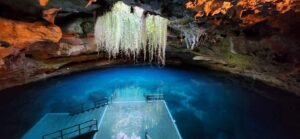
Why here: Diving inside a prehistoric cave — you descend through an opening in the earth into a domed cavern where shafts of daylight cut through the water and Pleistocene fossils line the walls.
Devil's Den is a privately owned karst cavern, not open water: everyone must snorkel or dive, and general swimming isn't allowed. Diving is $48/person, first-come first-served, Open Water certification required; snorkeling is $30 (reservation required). The den is 50+ feet deep with no shallow areas and no flotation devices permitted, so it demands genuine comfort in water. Ancient fossils dating to the Pleistocene are embedded in the walls. Ages 6+, under-18s need a guardian. The light beams through the ceiling opening are strongest midday.
Best for Open-water divers wanting a unique, photogenic cavern; confident snorkelers. Book the first slot for the emptiest water.
Verify before you go Dive and snorkel rates verified against devilsden.com July 2026, but confirm before travel.
Full guide, map & conditions →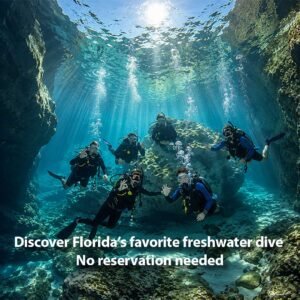
Why here: Florida's best training cavern — a lit, guideline-equipped cavern with a submerged air bell at 30 feet where you can surface, take out your regulator, and chat with your buddies underwater.
Blue Grotto is a private dive-only resort ($61/diver daytime, verified): no general swimming, water access is for certified divers (and limited weekday snorkelers). The cavern reaches 100 feet with 100-foot visibility, permanent guidelines, and underwater lighting, making it exceptionally safe for open-water divers (recommended 60-foot max). The famous air bell at 30 feet is fed by a surface compressor. A separate cave requires full cave certification and a guide. Say hi to Virgil, the resident softshell turtle. Weekends fill with classes that stir up the basin — early morning or late afternoon is clearest.
Best for Open-water divers wanting a safe, feature-rich cavern; training. Avoid weekend midday when classes cloud the water.
Verify before you go Rates verified against divebluegrotto.com 2026.
Full guide, map & conditions →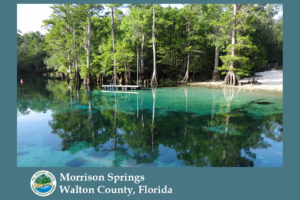
Why here: A free-feeling (now $4) county spring with a genuine cavern for certified divers and a gentle training basin — the Panhandle's most popular open dive site.
As of March 2026 Morrison charges $4/car (card only — it was free before). The 250-foot basin has a sandy sloped entry and a training platform at 18-25 feet, ideal for open-water classes. Certified divers can enter the cavern (rooms at ~35 and ~50 ft, reaching ~90 ft); the deeper cave was sealed after fatalities. No dive shop, rentals, or air fills — bring everything. The big caveat: the Choctawhatchee River backs up and muddies the spring after heavy rain, and the county closes it for water quality, so check the clarity report before driving.
Best for Open-water divers and classes wanting an affordable cavern. Check the county clarity report first — it closes after rain.
Verify before you go Fee verified against mywaltonfl.gov (new $4 charge, March 2026).
Full guide, map & conditions →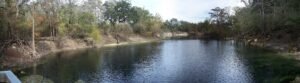
Why here: Dive over a Civil War shipwreck — the scuttled 1863 steamboat Madison rests in the spring run, its outline visible even from the boardwalk on clear days.
A first-magnitude state park spring ($5/vehicle) dropping to 70 feet, open-water-certified divers only — no solo diving, no cave penetration, no lights. The draw is the wreck of the Madison, sunk in 1863 to keep it from Union capture; do not touch or remove anything, as it's a protected archaeological site. Dives must finish before 5pm. Honest note: clarity here has declined and clear days are less frequent than they once were.
Best for Open-water divers wanting history and depth without a cave. Go on a forecast-clear day for wreck visibility.
Verify before you go Fee verified against Florida State Parks; confirm any separate diver rate.
Full guide, map & conditions →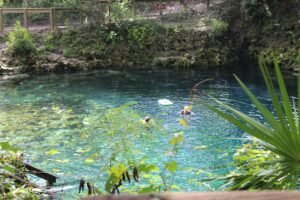
Why here: A world-class cave-diving destination — over 26,000 feet of mapped passage draw technical divers globally, while the blue basin above stays open to swimmers.
A first-magnitude state park spring ($5/vehicle, verified), 82 feet wide and ~25 deep, internationally known for its cave system entered at ~30 feet. Cave requires full cave certification (open-water won't do) and no solo diving. Recent operational notes from the park: frequent capacity closures 10am-3pm on weekends/holidays (don't wait in your car roadside — you can be cited), and large RVs discouraged as of April 2026 due to limited turnaround. Swimmers and snorkelers enjoy the basin.
Best for Fully cave-certified divers; swimmers wanting a gorgeous blue basin. Arrive early on weekends to beat capacity closures.
Verify before you go Fee verified against Florida State Parks; a separate per-diver fee has applied at times.
Full guide, map & conditions →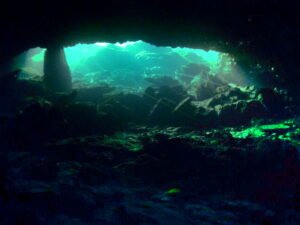
Why here: One of the longest underwater cave systems in the country — over 33,000 feet of mapped passage, and the training ground where much of the world's cave-diving certification happens.
Wes Skiles Peacock Springs State Park ($4/vehicle, verified) is fundamentally a cave-diver's park. Orange Grove Sink allows open-water diving for all levels, but the Peacock I and III entrances require proof of cavern or cave certification. No DPVs and no solo diving anywhere. Non-divers can swim at the designated Peacock I area, but facilities are minimal — no concessions. The systems are unforgiving and have claimed untrained divers.
Best for Cave-certified divers and those training toward it. Non-divers will find more to do at Madison Blue or Troy nearby.
Verify before you go Fee verified via dive-operator listings; confirm current rate with the park.
Full guide, map & conditions →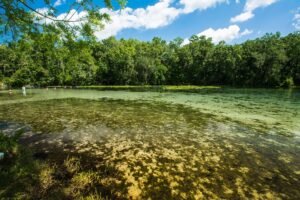
Why here: The best open-water spring dive for newly certified divers — the only scuba site in the Ocala National Forest, with a gently sloped 300-foot basin and a small cavern with a strong vent flow to explore.
A USFS site ($8 weekday / $11 weekend per person, verified) that's the only place in the Ocala forest allowing scuba. The broad basin slopes from 2.5 feet to about 25-30, so beginners can build confidence, and a small cavern with a strong outflowing vent adds interest for the certified. The $80/year Springs Hopper Pass covers Alexander plus Juniper, Silver Glen, and two lakes. Summer weekends (Memorial Day-Labor Day) require a Vehicle Access Reservation. Bring your own tanks — no dive shop on site.
Best for Newly certified open-water divers; snorkelers. Consider the Hopper Pass if touring multiple forest springs.
Verify before you go Fee verified against USFS/concessionaire; rates subject to change.
Full guide, map & conditions →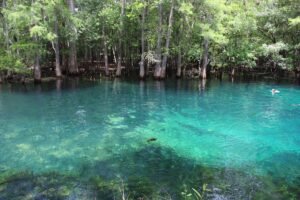
Why here: Cave diving at Catfish Hotel plus a first-magnitude basin — a Suwannee state park where certified divers explore an extensive system and winter brings manatees to the run.
A state park spring ($6/vehicle) on the Suwannee. Cave diving at the Catfish Hotel sink requires full cave certification. The main basin suits swimmers and snorkelers, and the park is an excellent camping base (see our camping guide). In winter, manatees enter the run and the swim area closes to people. High Suwannee levels back tannic water into the spring and kill visibility, so check river levels before a dive trip.
Best for Cave-certified divers for Catfish Hotel; campers combining diving with wildlife. Check Suwannee levels for clarity.
Verify before you go State park fee generally stable; confirm on Florida State Parks site.
Full guide, map & conditions →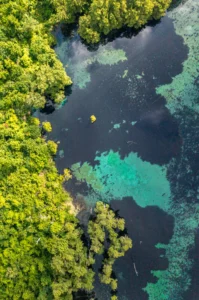
Why here: A first-magnitude spring feeding Merritt's Mill Pond, with caves along the pond that draw certified cave divers — a Panhandle system with county permitting.
Around $5/person as a Jackson County park (verify — seasonal). Jackson Blue heads the 4.5-mile Merritt's Mill Pond, and the caves along the pond edges draw cave-certified divers through a county permitting process. The swim area at the spring is seasonal (typically summer), so confirm it's open before driving; the pond paddles well year-round regardless.
Best for Cave-certified divers with county permits; summer swimmers.
Verify before you go Fee and season not independently confirmed this pass — verify with Jackson County.
Full guide, map & conditions →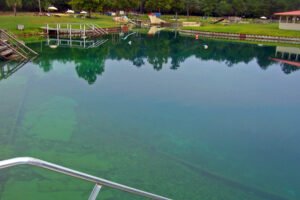
Why here: The Panhandle's dive-resort hub — a 50-foot basin with a cavern entrance, on-site air fills and instruction, and camping so you can dive, sleep, and dive again without leaving.
A private dive resort (~$20/person, seasonal — verify) near Ponce de Leon, built for training: air fills, rentals, lodging, and camping on site. The basin has a cavern entrance with posted certification requirements; non-divers get platforms and a slide. Thousands have certified here. Weekdays are quiet; weekends fill with classes.
Best for Divers and dive groups wanting to camp where they dive; certification students.
Verify before you go Private resort rates change seasonally and were not independently confirmed this pass — check Vortex's own site.
Full guide, map & conditions →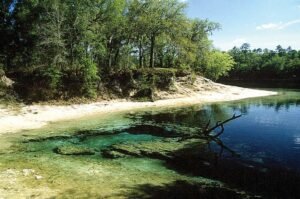
Cheap, uncrowded swimming with a serious cave system below. See the full guide for details and current conditions.
Full guide, map & conditions →