Should you go?
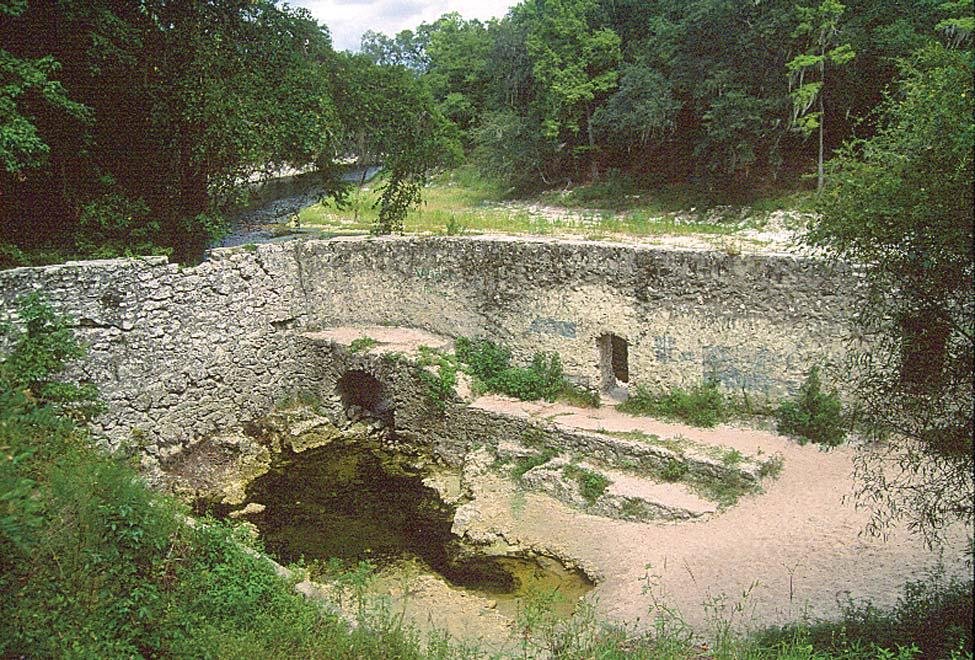
Suwannee Springs was a health resort in the 1800s — visitors came for the sulphur water, and the limestone walls of the old spring house still stand around the pool, with the remains of a hotel and bathhouses in the woods nearby.
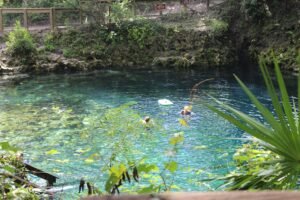
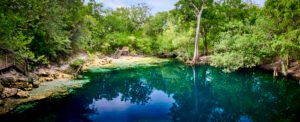
The water carries a faint sulphur smell and a mineral tint rather than the gin-clarity of the swimming springs, so come for the history and the setting rather than the snorkeling.
Is it worth it? Yes as a history stop and a quick add-on to a Suwannee River paddling trip or a stop along the Florida Trail, but not as a guaranteed swim — come for the intact 1890s bathhouse wall, the Graffiti Bridge next door, and three hotels’ worth of fire history, and treat the water itself as a bonus rather than the main event.
Visiting
Free and open sunrise to sunset. Six named springs cluster here, five spilling directly into the Suwannee River within a sandy 100-foot stretch at the base of a 35-foot bank. The main spring flows inside the original 1890s limestone bath-house wall — 15 feet high, 3 feet thick — the last standing piece of a grand hotel resort that burned down in 1925, ending the spa era entirely. What's left is genuinely a ruin you walk into rather than a manicured attraction.
Just up the road, the old 1931 US-129 vehicle bridge (now foot-traffic only) has become a well-known local landmark nicknamed the Graffiti Bridge — local artists continuously repaint it, and it's become a popular photo spot overlooking the springs.
Where you actually swim depends on the river: when the Suwannee runs low, the spring pools clear inside the old limestone walls, genuinely separate from the main river channel. When the Suwannee runs high, it backs up and flows into the spring itself, mixing in tannic, dark river water and erasing the clarity you'd get on a dry-weather visit — so the 'swim inside the ruins' experience and the 'swim in the tannic river' experience are really the same spot on different days, not two separate options. Suwannee River State Park, a developed state park with camping and a boat ramp, sits along the same river closer to Live Oak, making a reasonable pairing for a longer river trip, though exact driving distance varies by route.
When to go
Dry-weather months for the clearest water inside the historic walls. This is a nice add-on to a Suwannee River paddling day rather than a standalone destination trip.
Local tips
The Graffiti Bridge draws as many visitors as the spring itself: park where 93rd Drive dead-ends at the old 1931 span, walk around the vehicle barrier, and you're on the bridge on foot. Regulars bring their own spray paint to add to the ever-changing mural, and love locks have accumulated on the railings over the years, per visitor accounts. The Florida National Scenic Trail crosses directly beneath the bridge's end, so through-hikers often combine the two stops.
The spring itself sits down a short path just before the bridge via a right turn, inside the limestone bathhouse ruins; visitors describe genuinely clear water pooling within the old walls on dry-weather days, though the Suwannee River backing up after rain can cloud it out entirely, so this isn't a guaranteed swim the way a state park spring is. Because there's no lifeguard, gate, or staff of any kind, treat conditions as whatever you find them, and don't expect posted signage warning of hazards the way you'd get at a developed park.
Facilities amount to a single portable restroom, so this works best as a stop of an hour or two rather than a full day out; pack your own food, water, and sun protection, and don't expect much shade over the sandy approach. The ruin's footing is uneven limestone and old foundation stone, not a maintained pool deck, so water shoes make more sense than bare feet or flip-flops.
Combine it with a Suwannee River paddling trip — there's a boat ramp on site, and the spring makes a natural lunch stop for a longer float. Cell signal in this stretch of rural Suwannee County near Live Oak is inconsistent, so download directions and any maps in advance rather than relying on a live connection once you're off US-129.
Live Oak, about 7.5 miles southwest, is the closest town with gas, groceries, and restaurants — there's nothing to buy at the spring itself. If the water looks brown or murky on arrival, that's tannic river water backing into the spring after rain rather than a water-quality problem; it usually clears again once the Suwannee drops.
Rules & restrictions
Free and unstaffed. The ruins are uneven — wear real shoes. Water is sulphurous, not clear.
Good to know
Dogs: Yes, leashed. Season: Year-round.
Facilities
Genuinely rustic — a portable restroom and minimal facilities, nothing more. Bring water, food, and sun protection, since there's nothing on site to buy. A boat ramp provides river access. The Suwannee River Water Management District, which manages the site today, has kept development deliberately minimal — boardwalks and picnic areas were added for access and safety, but no attempt has been made to rebuild or replicate the resort that once stood here.
Wildlife you may see
Birds along the river and the occasional otter. The ruins themselves are the attraction rather than the wildlife.
History & background
Stephen Foster's 1851 song 'Old Folks at Home' — Florida's official state song — immortalized the Suwannee River, and this spring sits right along that same stretch. In the late 1800s, travelers came by rail specifically to 'take the waters' here, staying in a grand hotel and bathing in a stone spring house built around the boil, until the hotel burned in 1925 and the resort era ended for good.
The full history is more dramatic than one fire: according to a detailed history of the resort, Francis J. Ross bought the spring and surrounding land around 1831 for $5,000 and built a resort that could sleep 150 guests, with weekly stagecoach service from Tallahassee and Jacksonville. Ross sold the property in 1838 amid the financial strain of the Second Seminole War, and the resort didn't reopen until 1842, once improved ferry and bridge access made the site reachable again.
The first postwar hotel, a five-turreted, 125-room wooden structure, burned down on January 17, 1884 — barely finished; the New York Times reportedly called it one of the finest hotels of its kind in the state. A second, 25-room brick hotel went up in 1885, marketed as the 'Suwannee Sulphur Springs Resort and Sanitarium' and expanded well beyond a simple bathhouse with exercise courts, a bowling alley, and its own water-bottling plant selling the mineral water off-site — a level of commercial ambition that makes the enterprise's eventual collapse more striking.
That second hotel also burned, in 1901, and a third wooden-roofed hotel was lost to fire in 1925, finally ending the spa era for good. By then, doctors had also stopped believing the sulphur water had the healing properties it was originally marketed on, which took away much of the remaining draw.
What's left today — a handful of old cottages and the limestone spring-house walls — is genuinely all that survives of three separate hotels lost to fire over roughly forty years (1884-1925), and despite repeated talk over the decades of rebuilding cabins or a hotel on the site, none of it has attracted real commercial interest since.
Map & directions
FAQs
Is Suwannee Springs free?
Yes, free and open sunrise to sunset, managed by the Suwannee River Water Management District.
What is the Graffiti Bridge near Suwannee Springs?
The old 1931 US-129 vehicle bridge, now foot-traffic only, continuously repainted by local artists — a well-known local landmark and popular photo spot overlooking the springs.
Are there facilities at Suwannee Springs?
Very minimal — a portable restroom and not much else. Bring your own food, water, and sun protection.
Is Suwannee Springs good for swimming?
It's more of a history stop than a premier swimming destination — the mineral water is tinted rather than crystal clear, and clarity depends heavily on the Suwannee River's current level.
How many hotels once stood at Suwannee Springs?
Three, across roughly forty years (1884-1925) — all lost to fire. The first, a 125-room wooden hotel, burned within months of opening in 1884; a 25-room brick replacement burned in 1901; and a third wooden-roofed hotel burned in 1925, ending the resort era for good.
Why did people originally visit Suwannee Springs?
For the sulphur mineral water, which 19th-century visitors believed had healing properties. That belief faded as medical understanding of sulphur water's actual effects improved, and the resort's popularity declined along with it.
Where do you park to see the Graffiti Bridge near Suwannee Springs?
93rd Drive dead-ends at the old 1931 bridge — park there and walk around the vehicle barrier onto the bridge on foot.
Can you paint on the Graffiti Bridge?
Yes, informally — visitors regularly bring their own spray paint to add to the mural, and love locks have accumulated on the railings over the years.
Does the Florida Trail pass through Suwannee Springs?
Yes — the Florida National Scenic Trail crosses directly beneath the end of the historic bridge next to the springs, making it a natural stop for through-hikers.
Why did Suwannee Springs' resort era end for good?
Three separate hotels here burned down over roughly forty years (1884-1925) — the last in 1925 — and by then, evolving medical understanding had also discredited the belief that sulphur water had healing properties, which took away much of the resort's remaining commercial appeal.
Is Suwannee Springs water tannic or clear?
Both, depending on river level. When the Suwannee River runs low, the spring pools clear inside the old limestone walls; when the river runs high, it backs into the spring and turns it tannic and dark like the river itself.
Is Suwannee River State Park the same place as Suwannee Springs?
No — they're separate sites on the same river. Suwannee River State Park is a developed state park with camping near Live Oak; Suwannee Springs is the unstaffed historic ruin site covered here.
What town is closest to Suwannee Springs for food or gas?
Live Oak, about 7.5 miles southwest — the nearest town with restaurants, groceries, and gas. There's nothing to buy at the spring itself.
Visitor photos
See this week’s shots: Instagram #suwanneesprings · TikTok #suwanneesprings
Great for: Free Entry · Kayaking · Swimming